El Calafate Again
DéjàVu All Over Again
Tuesday February 12, 2008
Why do we keep coming back here? I suppose because it is where it is and there ain't much else in the neighborhood. And we did eat a couple of those calafate berries, although I recall giving up on them after trying one or two under-ripe tart ones, and that was back in Torres del Paine, Chile. I can believe in legends, and that there might be something magical in the calafate berries, but it's a stretch to think that eating one or two of them in a national park in Chile would force us to return to El Calafate, Argentina three times. OK, OK, I'll just have to admit it. The legend and mystical power of those berries is real.
Before leaving Hosteria Monte León to drive back to El Calafate, I drove north along the coast for half an hour in order to get to a small town where I could buy gas and make some phone calls. Armed with some guidebooks and brochures, I continued calling several different hotels and estancias after our first choice (returning to the cabañas we had stayed at before) turned out to be booked. It was the third or fourth call to the third or fourth choice before I found someone willing to take a reservation for at least a night or two, so I made the reservation, returned to Monte Leòn to eat lunch (one more fabulous simple meal featuring fresh garden vegetables!), gather up the family and the luggage, and then head back on down the road to the place that the eating of little blue berries on a thorn bush had mandated we must return to, apparently over and over again.
As noted in the last journal entry, we had a flat tire and a more-dust-than-usual experience on the return drive, so we were a little tired and very dirty (at least I was) when we pulled into town shortly after 6pm. After just a small amount of meandering through the unmarked one-way streets* of El Calafate. We found the hotel that had given us a reservation . Anna, who had to use the restroom quite urgently, came into the lobby with me and then went with me to look at the rooms - dingy, small, and very disappointing. Since we were pointed away from the hotel on a one-way street, the path back to the parking lot was rather convoluted, but the upside was that we could drive by a handful of other hotels on the way - and we took advantage of the diversion, stopping and running in quickly to check availability at each and every "nice looking one" along the way. On the second or third attempt at an improbably upscale-looking hotel we struck pay-dirt. They had a two bedroom suite available and offered a 40% discount if we stayed more than two days. Emergency change of plans! The front desk called the other hotel for me (but let me do the talking), I apologized for running out on them but the receptionist said something like "no problem have a nice day," and we were set.
So for the past almost-week, we've done very little other than to do a lot of schoolwork (speaking of Anna, Tom, and teacher Lynn), and enjoy our comfortable hotel and the tourist conveniences of El Calafate. For me to go back to the states to attend the memorial service for my former boss I would have had to leave for home ASAP - by Saturday morning at the latest. I started hunting for flights shortly after we came into town, and was soon surprised and amazed to find that flight options and logistics were almost impossibly difficult (domestic flights to/from San Francisco or Oakland being one of the biggest problems) and the cost alarming, unless I was willing to stay more than a day or two. Leaving the family on their own for very long just didn't seem too wise, so eventually I gave up and forwarded on my condolences - a difficult decision but I believe the right one.
After two days of straying no further from the hotel than our legs would take us, we went on a bonified excursion on Sunday, driving about 10 kilometers out of town to visit the site of some rock and cave paintings made by the Neolithic ancestors of the Tehuelche people. Europeans found this part of South America inhabited by Tehuelche when they arrived in the 16th century, but having no written history, the Tehuelche knowledge of their own ancestors was via oral legend only. So there is a "pretty good but still with a bit of educated quess-work" sort of understanding of the purpose and function of the historic ceremonial sites meaning of the various cave paintings and symbols. The specific site we visited is called Punta Wapichu.
The various paintings and ceremonial sites located here were noted and described in detail by the explorer Perito Moreno, but due to their close proximity to the settlement of El Calafate and subsequent heavy visitation over the years (without physical protections in place), those which remain today have suffered a lot of wear and tear. It is still a pretty interesting site never-the-less, and perhaps because the weather forecast was iffy, we were the only people there in the early part of a breezily fresh Sunday afternoon. So we got a personal tour from a young woman who walked us around and explained all the paintings, symbols, and ceremony sites.
Of course, there is a geological history to this place that pre-dates the Neolithic pre-Tehuelche people by a few billion years. At one time, South America was part of the uni-continent of Gondwana, and at one time, this part of Gondwana was lush forestland inhabited by dinosaurs. The geological eons have produced various layers of assorted rock types, fossils, and as we saw a little over a month ago, burial grounds of giant petrified trees.
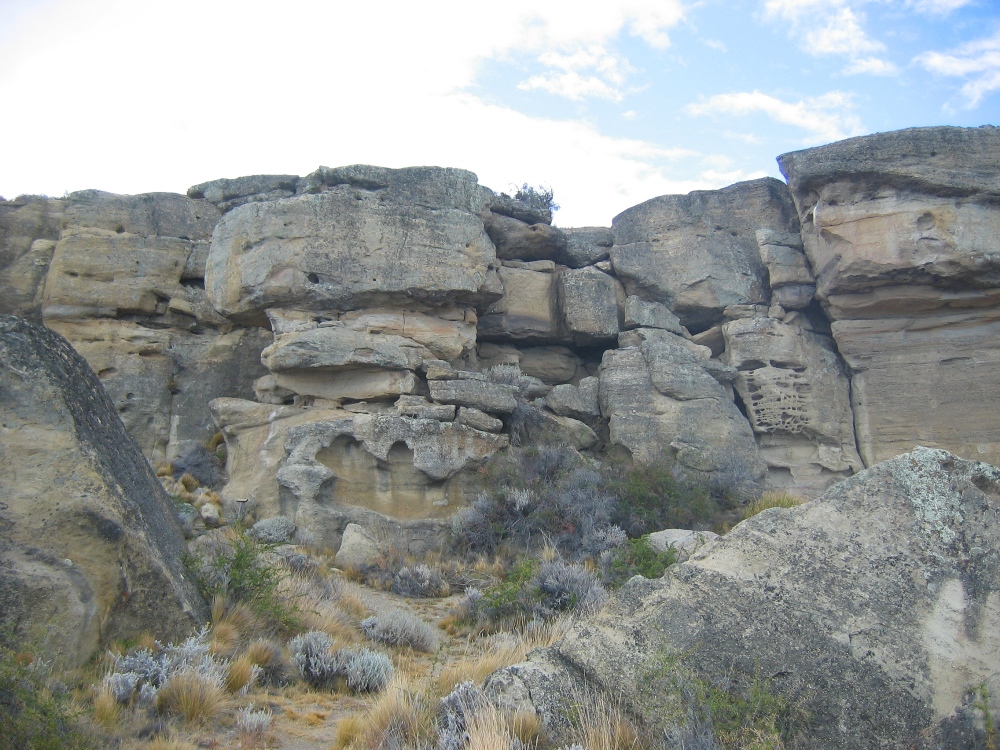
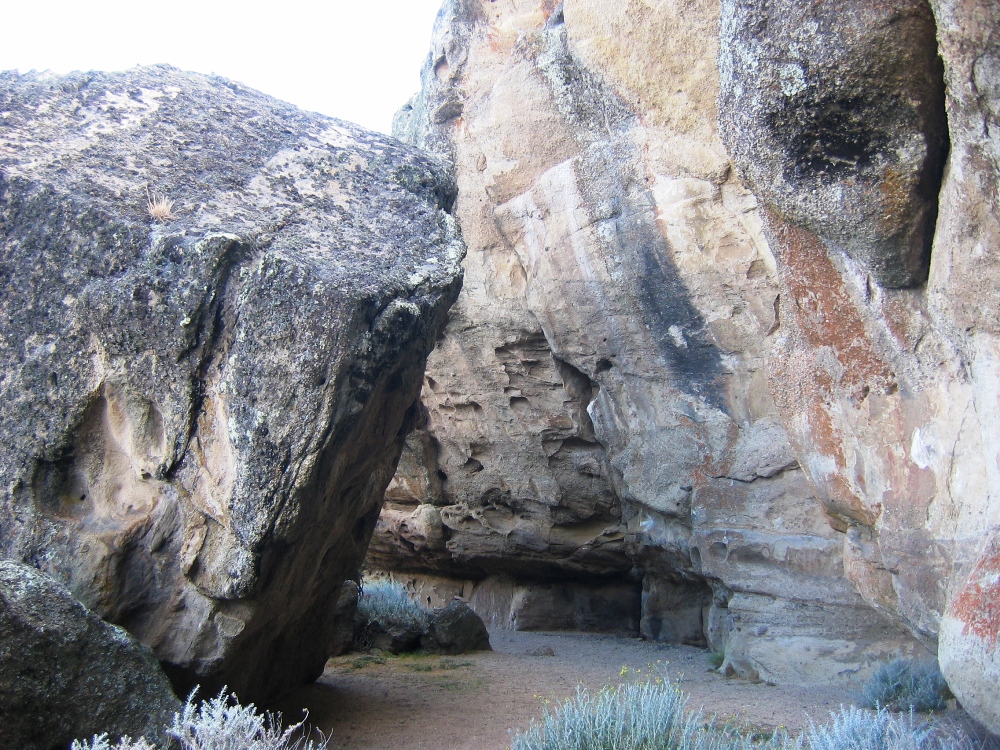
The cliffs of Punta Wapichu are layered sedimentary remnants of ancient seabeds, subsequently carved and whittled away by numerous glaciations.
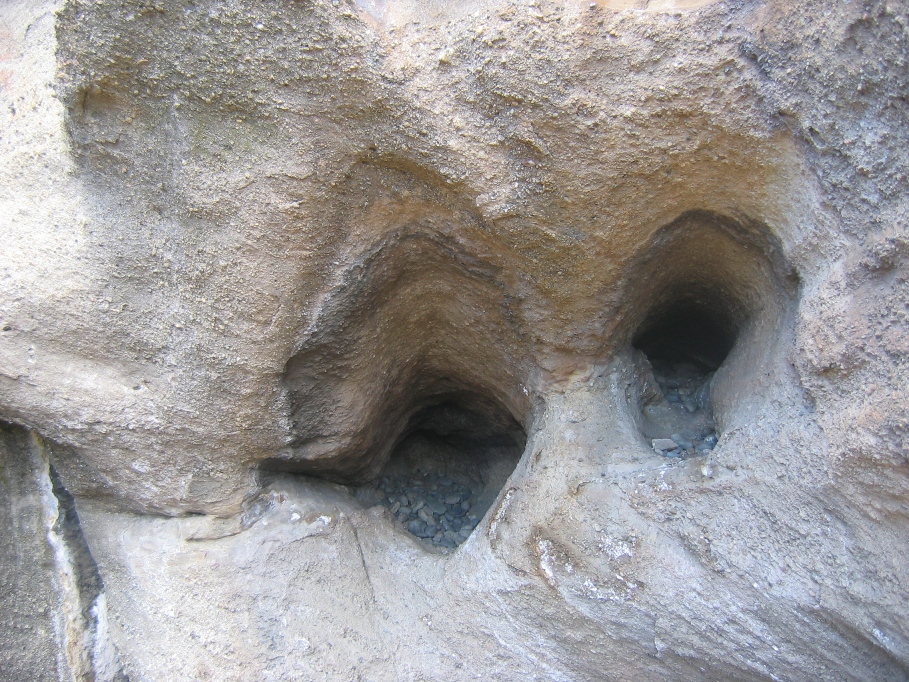
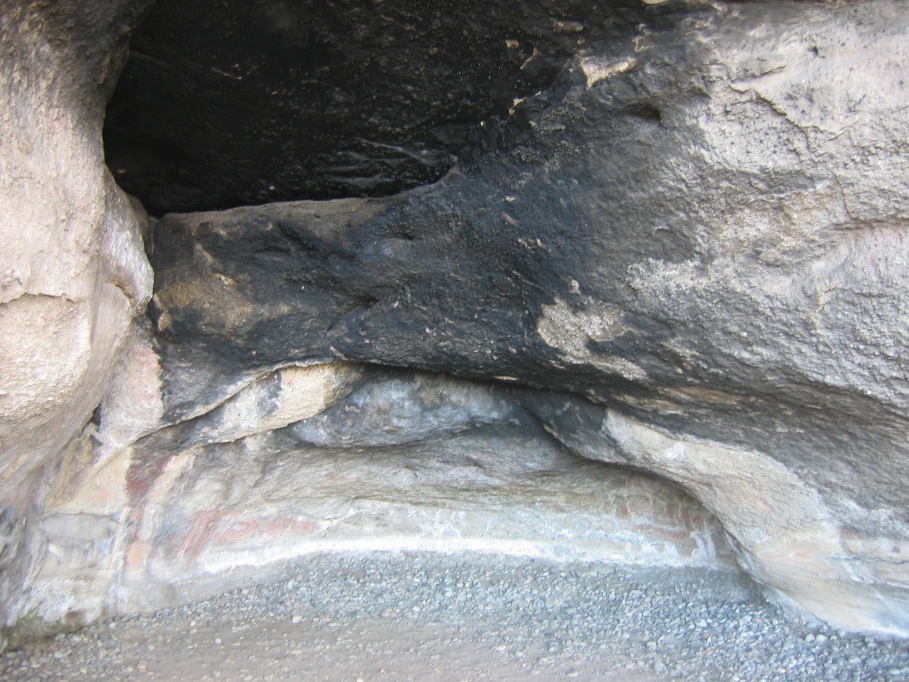
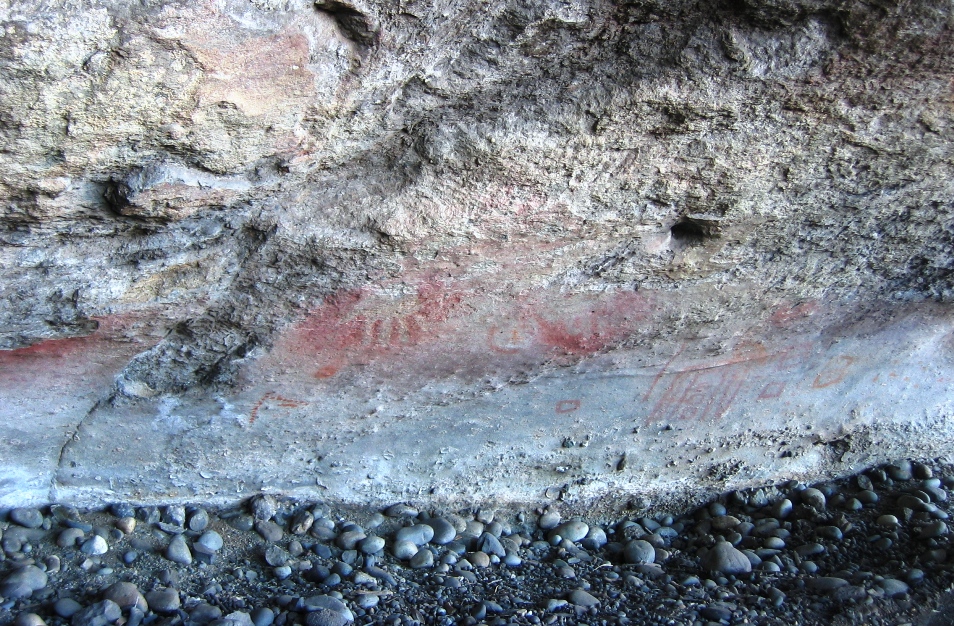
Alongside the cliffs and inside under-cut caves, we saw the evidence left behind by the first people to live here. Left to right: two holes excavated into the rock wall and used as a crematorium; a cooking and/or ceremony fire pit; paintings on the rock.
Some of the paintings of hands are positive images (dark paint in the form of the hand) and others are negative images (dark paint surrounding the outline of a hand). Our guide told us that the positive images are believed to signify the live person, and the negative images represent their soul or presence in the after-life or other-world.
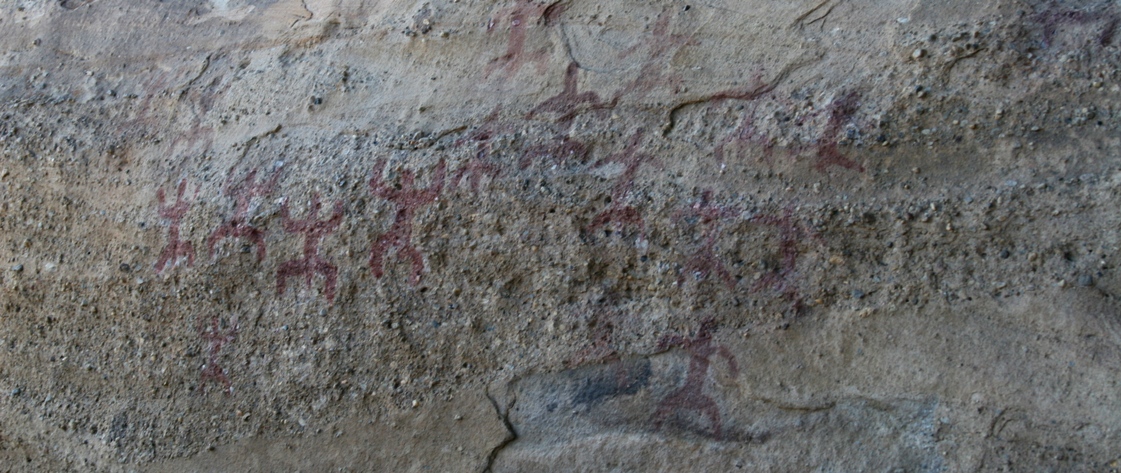
The ceremonial sites and rock paintings here encompass an entire "circle-of-life" theme and story of the people made and used them. From birthing and fertility sites (not just symbolic representations, but actual birthing places), to the crematoriums, to the after-life, its all here, and we could take it all in with a short walk of just a few hundred yards along the cliffs.
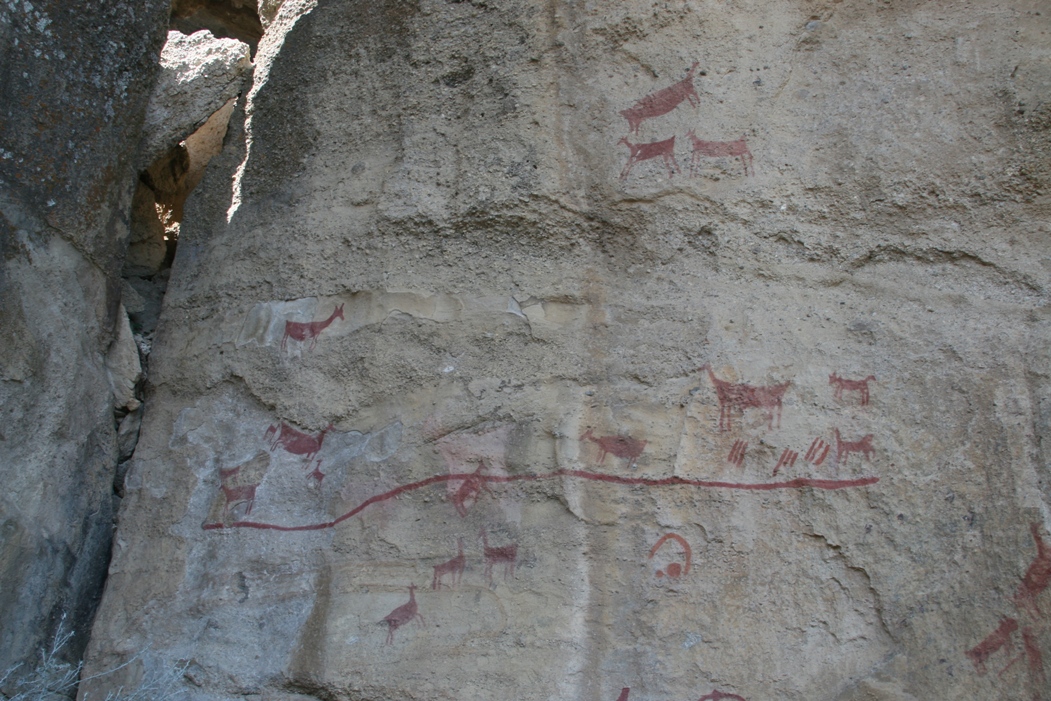
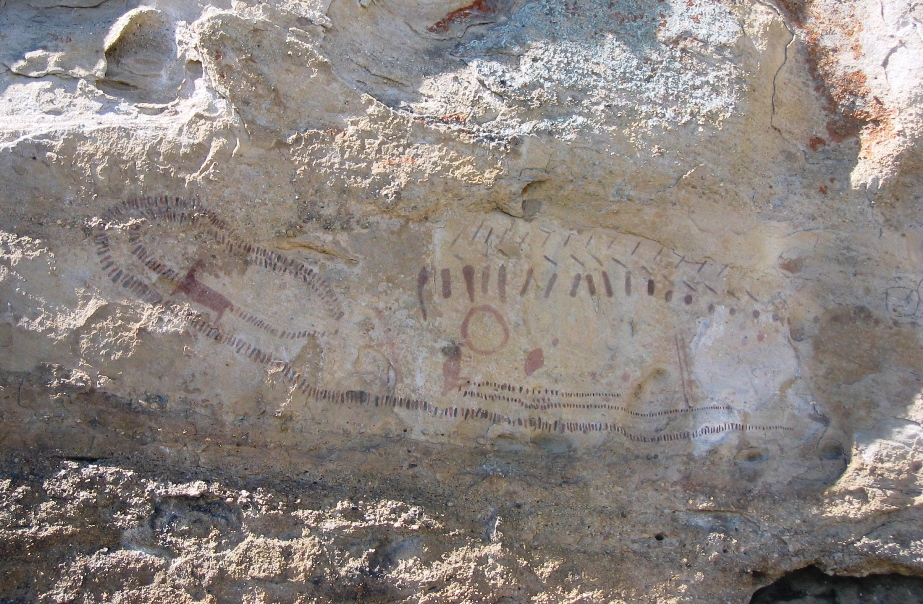
These two sets of paintings were recently "added" by archeologist/artists as representations of the actual paintings found in other locations of this region. One of the curiosities evident is that these reproductions (made with an attempt to use the same materials used in the production of the originals) seem to have weathered and eroded much more rapidly than the originals. The originals have been in place for several thousand years, and the reproductions only for a few decades. Obviously, the archeologists still haven't figured out how to exactly reproduce the painting technique. Or as our guide suggested, maybe it is a spiritual component that's missing from their process.
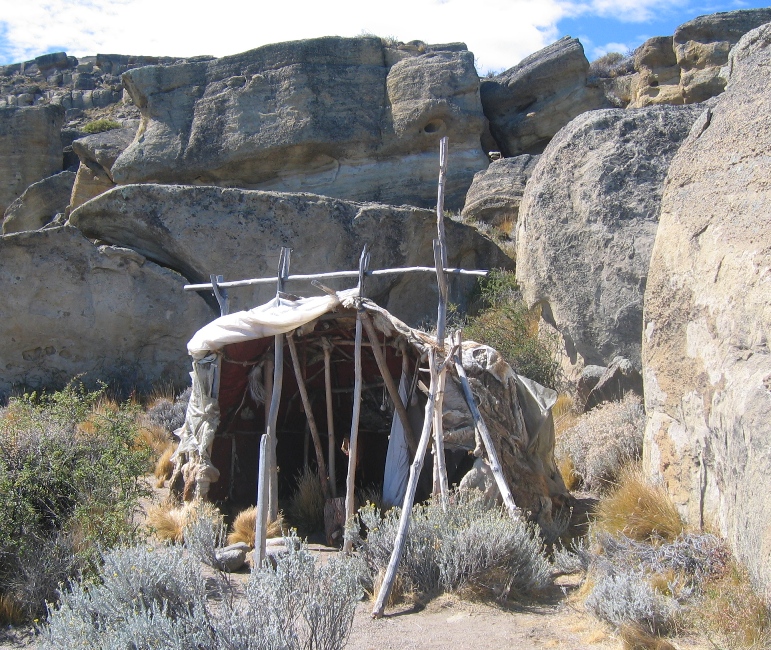
Just outside of the small visitor's center, there is a reproduction of a Tehuelche "prairie tent," as our guide pointed out, this version is from the "post-white-man" era and has incorporated the skins of animals (like sheep) brought by the Europeans.
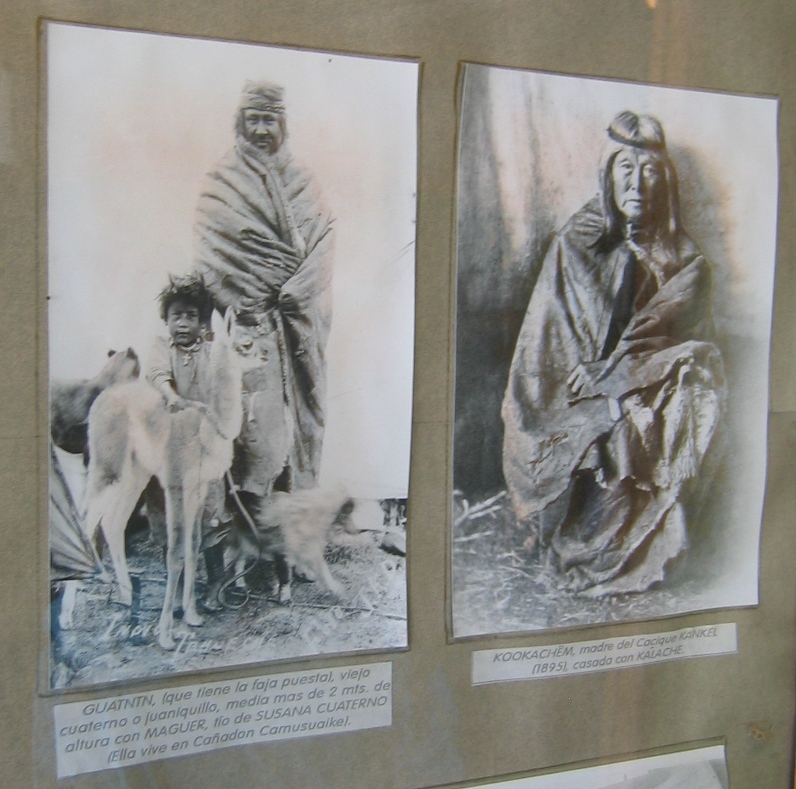
Back in the office/cafe, there is a small museum with pictures of Teheulche natives of the region, arrow heads found on the property, and some geological charts showing the physical history of this place. According to our guide, the last true Tehuelche person of un-mixed blood died a few decades ago.
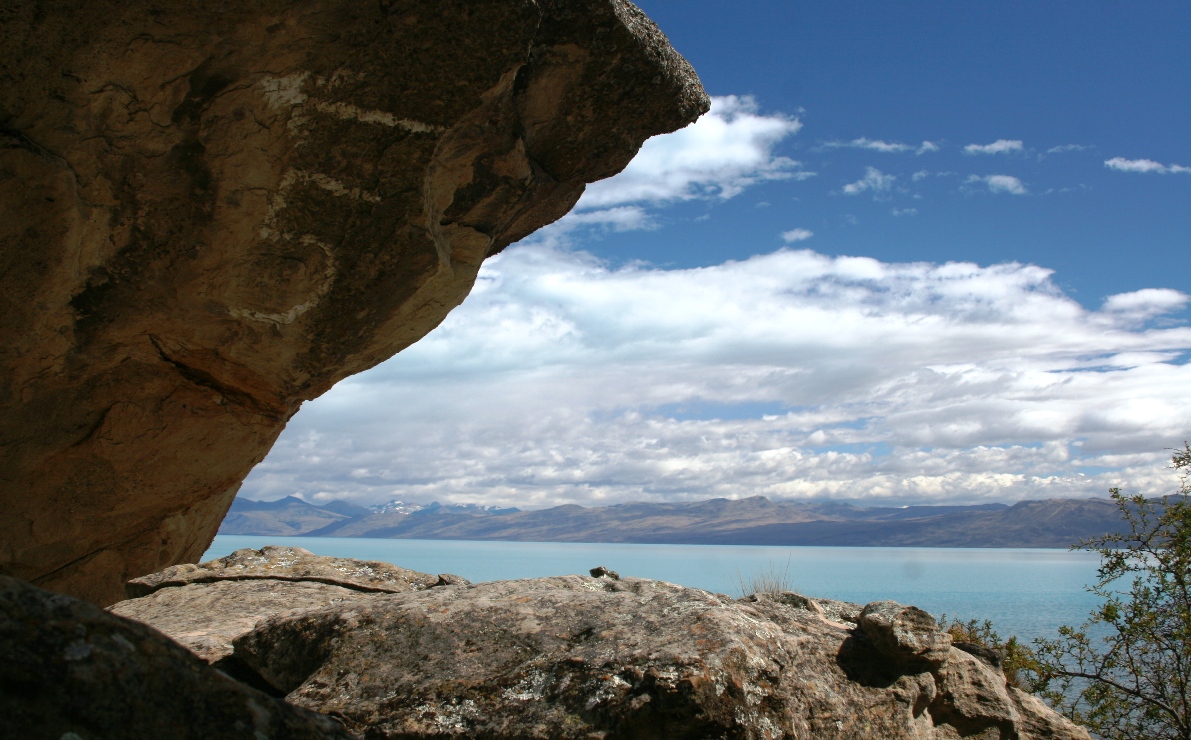
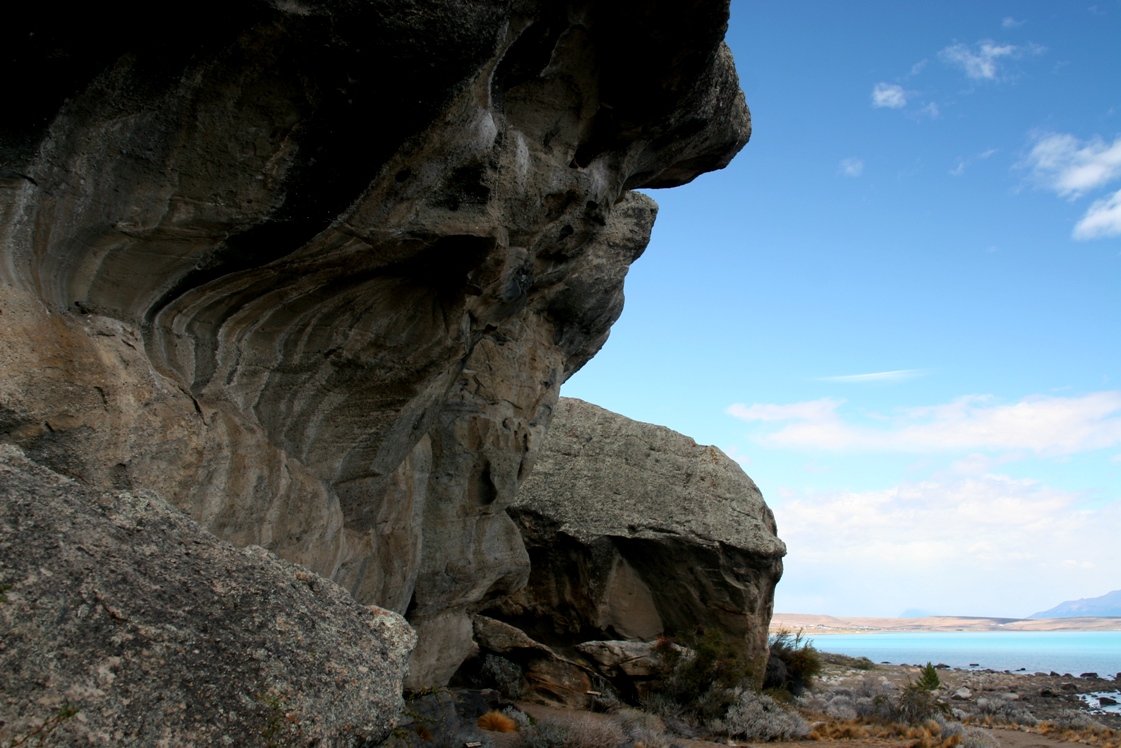
Parting shots of the ever-turquoise Lago Argentino framed by the cliffs and rocks of Punta Wapichu.
Tomorrow, we'll finally escape from El Calafate for presumably the last time, heading north for estancias and small towns in the middle of almost nowhere - which means no internet for perhaps as much as a week or more! We hope the civilized (and connected) world can keep on churning along just fine without our knowing too much about it.
-Rolf
*As far as I can tell, out of the several hundred intersections in the town of El Calafate, not a single one is marked with a stop sign, yield sign, traffic light, or any other indication to help drivers figure out who should go first. On top of that, most of the streets are one-way, and only a few of the intersections have signs indicating which way is the only way you are supposed to drive. The good news is that, instead of producing bedlam and accidents, the situation seems to have the opposite effect. People drive slowly and carefully, especially when approaching intersections - although I have seen more than one unwitting outsider driving blissfully unaware in the obviously wrong direction down a one-way street. The oncoming vehicles usually just move over and flash their headlights in a semi-polite "Hey!" sort of way - I haven't observed an accident, road-rage incident, or police officer handing out a citation in the now almost two weeks we've spent in this town...