Iceland
Iceland is an Island in the North Atlantic Ocean, just south of the Artic Circle. Although the climate is rather cold, Iceland is teeming with volcanoes and hot springs. There is even a volcano under a glacier. Many geological features exist including volcanoes, glaciers, rivers, waterfalls, geysers, and hot springs. All of them have come to shape Iceland.
The thing that caused most of these features to exist is plate tectonics. The theory of plate tectonics states that the pieces of the earth's crust are in constant, slow motion, driven by convection currents in the mantle. As it happens, Iceland is just right on top of a boundary between two plates. These plates are slowly spreading apart, so there is a crack in the ground. Wherever magma can reach the surface, it is called a volcano. The two basic kinds of volcanoes are shield, and cone. A cone volcano forms when viscous lava is exploded out and layered on top over many years. An example of a cone volcano in Iceland is Mount Hekla. Shield volcanoes form when non-viscous lava, called "pahoehoe", flows over any opening in the ground where magma is escaping. This makes a distinctive "shield" shape. An example of a shield volcano in Iceland is Trolladyndia.
Volcanos have been a part of Iceland for many years. There have been accounts of whole Viking villages destroyed by lava. In 1963, a new island called Surtsey erupted from the sea. Mount Hekla has erupted many times and is still very active. These have definitely come to shape Iceland.
Another mojor feature on Iceland are the Glaciers. A glacier forms in a place where it snows more than it melts. Piles of snow are compressed until they become solid ice. This is called an Ice Pack. Once gravity pulls it down and it begins to move, then it's a glacier. Glaciers move in two ways. One way is that it glides on a film of water on the bottom of the glacier. The other is that the ice is broken into layers which slide on top of each other. Glaciers are in many places. The largest one in Iceland is called Vatnajokull, and it is also the largest glacier in Europe. In the summer, parts of the glacier melt which forms many rivers.
The rivers in Iceland carry silt and they cut through the land, shaping new gorges and valleys. These rivers supply Icelanders with plenty of fish. There are also some very high cliffs where rivers go off of to make waterfalls, the highest one being Glydur, which is over 650 ft tall. Inside the glacier Vatnajokull is a volcano, which erupts occasionally. When this happens, tons of meltwater burst through the glacier and flood all of the nearby towns and farms. This is called a glacier burst. Icelanders are used to this happening, yet it still affects the way people live in Iceland.
Hot springs are another major feature on Iceland. A hot spring is like a normal spring, but the water is heated underground by hot rocks. These springs give off an odor that is like rotten eggs. This is caused by the amount of sulfur in the spring. When a hot spring bursts periods periodically into the air, it's called a geyser. A geyser forms when the hot water begins to rise through narrow passages in the rock. Heated gasses are forced up these passages by the pressures of the hot water below. Pressure builds, and the the water, steam, and gasses are ejected out of the top, high into the air. Hot springs are very important to Icelanders. The water is very pure, so that's what they use for tap and drinking water. They also make very good hot tubs, ranging from 35C to 40C. These hot springs have come to shape Iceland, both recreationally, and economically.
Iceland is still changing very rapidly. The crack in the ground is getting one centimeter bigger every year. Glaciers, volcanoes, and rivers change the landscape. Yet it is still very beautiful and should be protected from destruction. As Iceland becomes more industrialized, pollution could hurt, or even destroy these features. If we learn more about these features, then we can protect them, because these features are a part of Iceland.
Here are some pictures to illustrate the topics above:
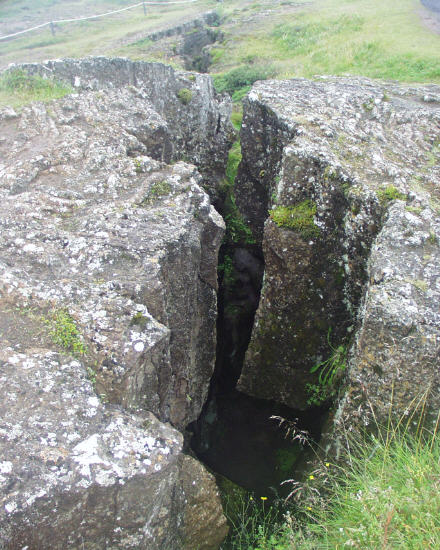
This is the crack running down the middle of Iceland where the North American continental plate meets the European continental plate.
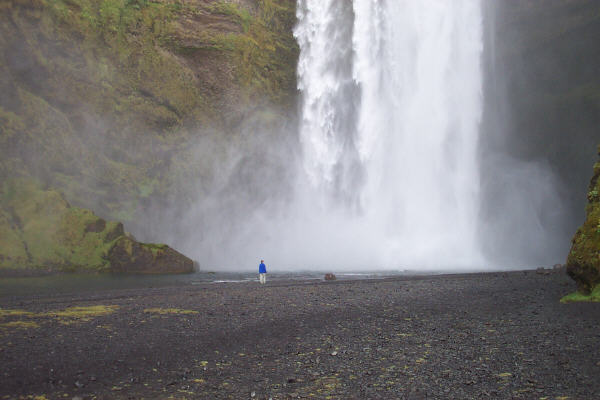
Here is a picture of me walking up to see a large waterfall in Iceland.
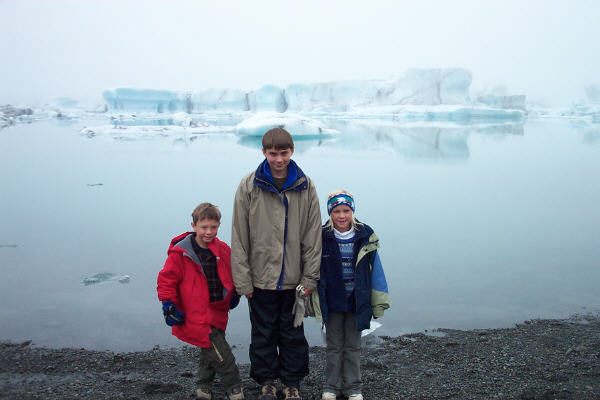
Here is a picture of me with my brother and sister, standing in front of a lagoon filled with icebergs that broke off of the Vatnajokull glacier.