Calama
Ice Cream, Big Hole in the Ground
Friday August 3
An oasis must have a desert surrounding it. When we left the fruit trees and warm natural springs of Pica, we were driving in the driest part of the driest desert on earth. There is not sign of birds, lizards, bugs, or vegetation of any sort for vast expanses. Then a smattering of dusty short little trees appear scattered off the side of the road. Lynn explained to us that there is ground water in places (in addition to the occasional surface stream), running down from the Andes. These trees have a tap root that extend extremely deep to find an slurp up the water. There used to be many more of these trees all throughout the Atacama, but a century of nitrite mining activity eradicated most of them as they were chopped down for firewood. Now there is nothing but miles and miles of rocks and dust.
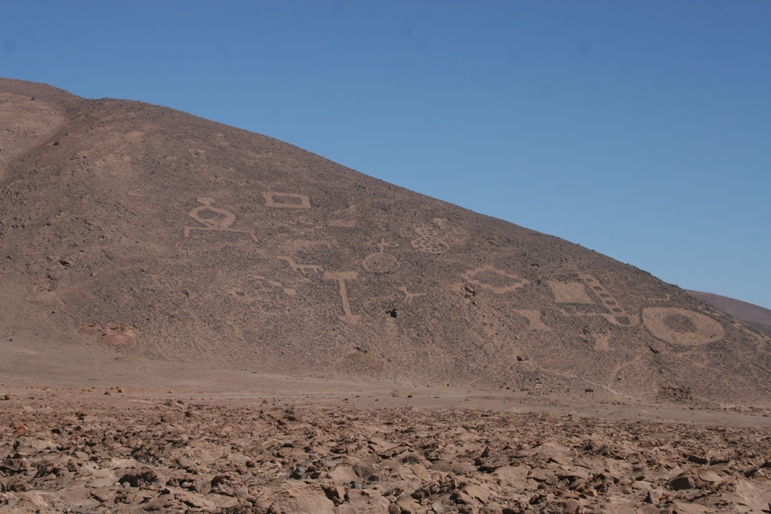
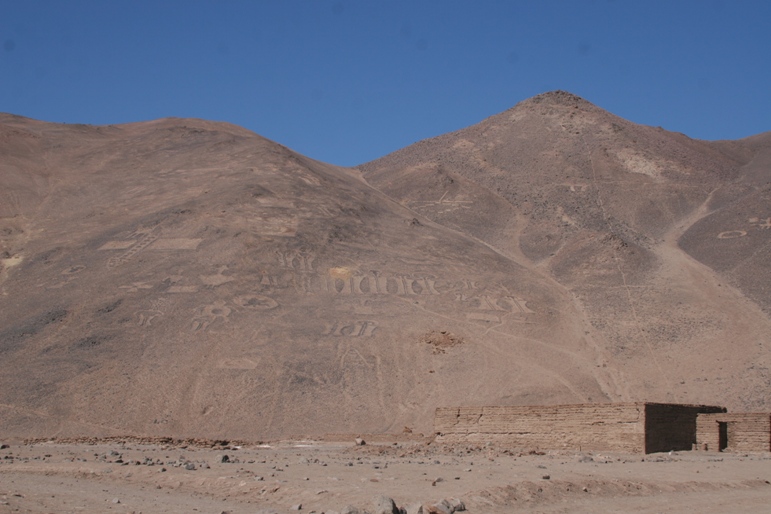
After driving 35 kilometers southwest from Pica back to the Pan-American highway, we took a short detour to drive alongside a sequence of geoglyph covered hills known as Cerros Pintados. These glyphs were created not by piling up rocks in a pattern, but by removing rocks and scraping the ground flat. The lack of any significant rainfall has allowed these simply created figures to remain sharp and clear for over 1000 years. There are hundreds of them scattered for several kilometers along a ridge of hills. Of course we played games trying to guess what they meant and describe what they looked like to us - "a bunny!" "an alien riding a dog!" Lynn asked us if we thought that there were only glyphs like this is certain, spiritual or special places - or if perhaps they used to be almost everywhere and it is only in the driest places that they have been preserved. Hmmm, to be honest.... I have no clue.
Although the desert around Cerros Pintados is rugged and dry (enough so that Nasa tested the Mars rover here), the driest was still to come. We drove south on the Pan-American for a short distance until we arrived at the reverse checkpoint for leaving the tax-free zone. Now it was time to show the piece of paper they gave us when we drove up to Iquique a couple of weeks ago. The customs agent made me open the back of the truck. One look at the dusty mess of crammed luggage and he quickly lost interest and waved us onward. Just past the checkpoint a side road branched off to the town of Quillagua, which an Oxford University geology professor has carefully concluded to be the driest place on earth. It has rained here 4 times in forever, with an averaged annual rainfall of less than 0.5 millimeters. I think this is less than one drop of rain per year on each droplet-sized speck of land. There is nothing in Quillagua to see or no one there trying to capitalize on the notoriety of being dry (although there is a stream and a few of those amazing trees) - just a lot of old, crumbling, dusty, decrepit, hovels. Many if not most are unoccupied and truly in ruins. The limping legacy of an old nitrite mining town with nothing much going on anymore is not terribly attractive.
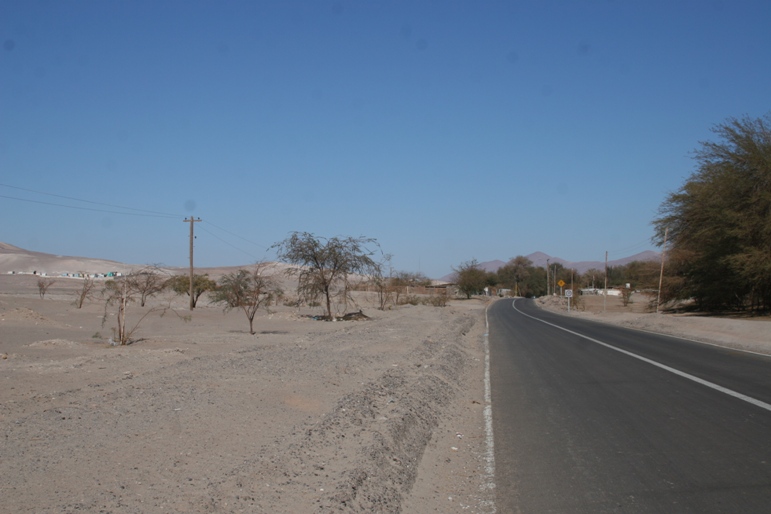
Driest place on earth - and there isn't even a sign to pose under.
After seeing a handful of dusty desert towns and cities in the Chilean Norte Grande, I wasn't sure what to expect from Calama. I knew it was fairly big (big enough to rate automobile dealerships and bank branches for all the primary makes and financial institutions), and near a huge copper mine. We passed the power plant for the mine/city about 50 kilometers before we arrived, and then drove under and alongside a maze of high tension wires the rest of the way into town.
I think we were all pleased with Calama and our stay here. Calama is compact and congested - a small town with a hectic hustle and bustle. There's a crowded pedestrian zone with street people and street performers and street dogs. People jump out in front of the traffic waiting at red lights and juggle glow-in-the-dark bowling pins for tips. All of this assorted entertainment is available within walking distance of our inexpensive hotel. It's as busy as downtown Santiago on a weekday, but here the people hang around late into the night to sing and chat and dance and play. In Santiago (or the part of it I visited), everyone seemed to just be in a hurry to get to work and then get home afterwards.
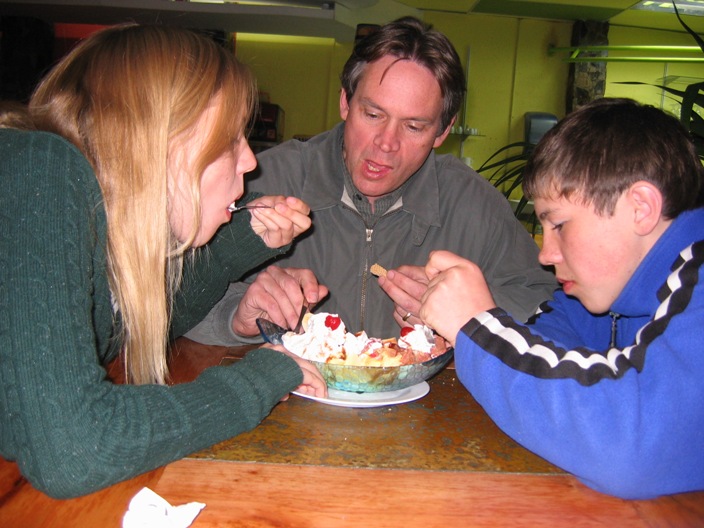
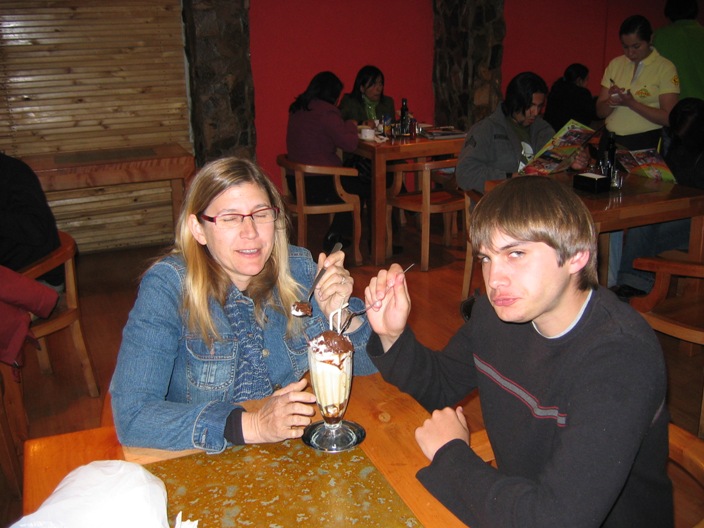
Walking through the pedestrian district in the late afternoon, Lynn and I found a cafe/restaurant with real espresso, pizza, and gelato. We returned with the kids for dinner. This was a welcome change of pace from comida chilena tipica. Huge ice-cream deserts were dispatched quickly and thoroughly by ravenous-gluttons who looked like us and sat in our seats for a few minutes at the end of the meal.
The hotel Mirador in Calama is not dirt cheap, but certainly cheaper than some other places we've stayed that didn't have as hot "hot water" or as clean "clean rooms." The breakfast here was weak, even by Chilean budget hotel standards. Instead of an ample supply of pancitos (stale bread hockey pucks), we get two pieces of toasted white bread per person (lacking in mass or substance) and all the hot water we could drink (flavored by one tea bag and/or a packed of nescafe). A small pan of hot scrambled eggs was provided upon request by the bored breakfast lady. We were amused by the breakfast menu, which lists three options in Spanish, French, and English. The English version reads:
Choice 1: Hot tea or coffee and juice. Pan of scrambled eggs with ham. Toast with jam and butter.
Choice 2: Hot tea or coffee and juice. Toast with jam and/or butter.
Choice 3: Hot tea or coffee and juice. Jams with toast and butter.
We didn't have the nerve to ask the server lady to explain the difference between the options and then order a mixture of choices.
This morning I drove to the Toyota dealer looking for an oil change and they told me to come back early tomorrow. Then after I parked and while I was walking up to our hotel, I noticed an armored bus dumping shackled, uniformly dressed, unhappy people onto the street. They trudged into the drab building next to our hotel under the humorless supervision of a half dozen armed guards.
Oh great, we're sleeping next to the jail! No wonder the rooms are cheap.
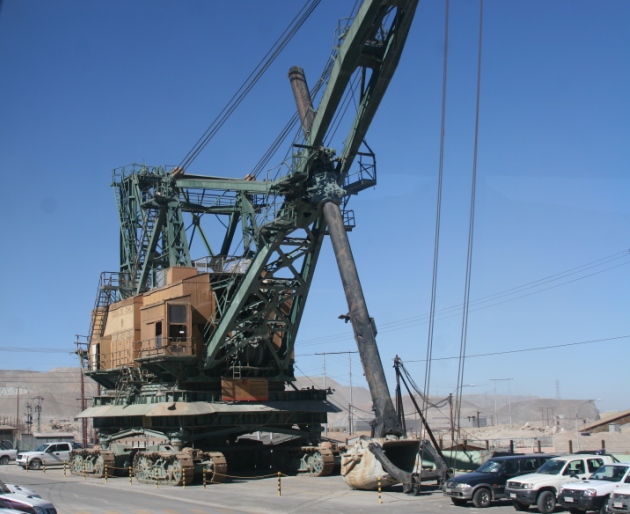
This afternoon we availed ourselves of the free tour at the Chuquicamata copper mine, a 20 minute drive from Calama. As per the tour description presented by our guidebook, we were expecting to don respirators and visit the smelter. No such luck. For some reason, that bit of entertainment is currently not part of the program. Perhaps the mine is just too dang busy to suffer tourists tramping around one of the more dangerous parts of the operation. The guide mentioned something about a world-wide copper deficit and how the Chilean, state-owned mining company is digging as fast as it can, at this mine in Chuquicamata and in/at various other facilities and projects around the country.
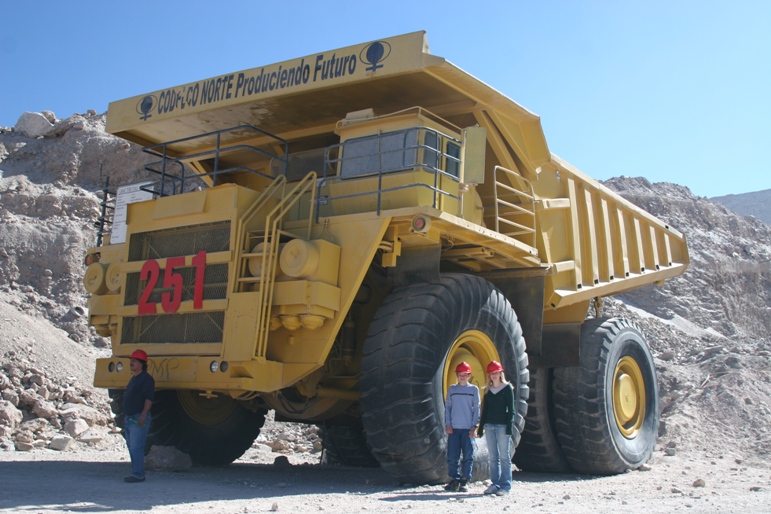
It was an amusing and fascinating diversion nonetheless. Now we know where those huge tires and assorted truck parts that we see being hauled up and down the highways are heading and how they are used. If anyone has a fascination with big trucks (or "big" in general), this definitely a place they'd want to visit.
OK - mine statistics: roughly gleaned and translated from the monologue of the Spanish-speaking tour guide by myself and various family assistants.
The open-pit copper mine at Chuquicamata uses more power than the city of Santiago. It has been in operation for over 80 years, and they estimate that it contains enough reserves of ore to continue operating for another 80. It is something like 5km long, 3km wide, and 2-3 km deep - currently. The hole is so big, those gigantic trucks looks like gnats crawling on a windowsill driving on the road far into the pit. I wonder how big the hole will be 80 years from now. As enormous as it looks, there is an even bigger mine just a few hundred miles away.
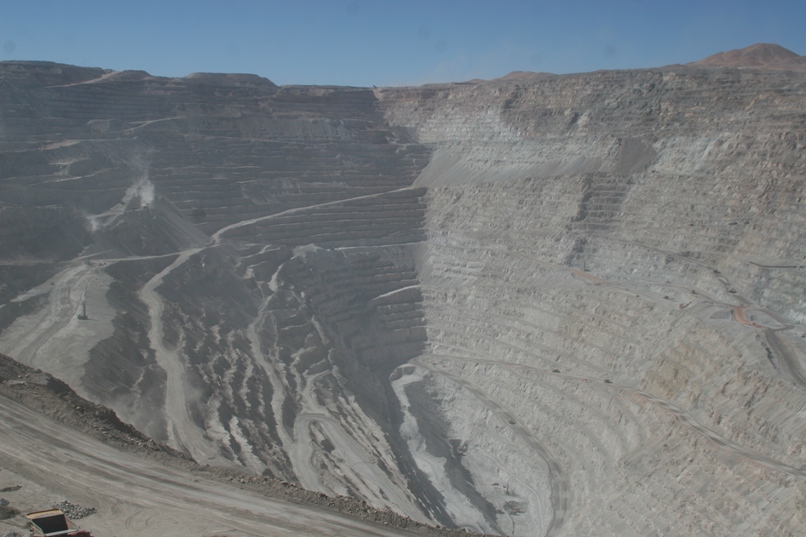
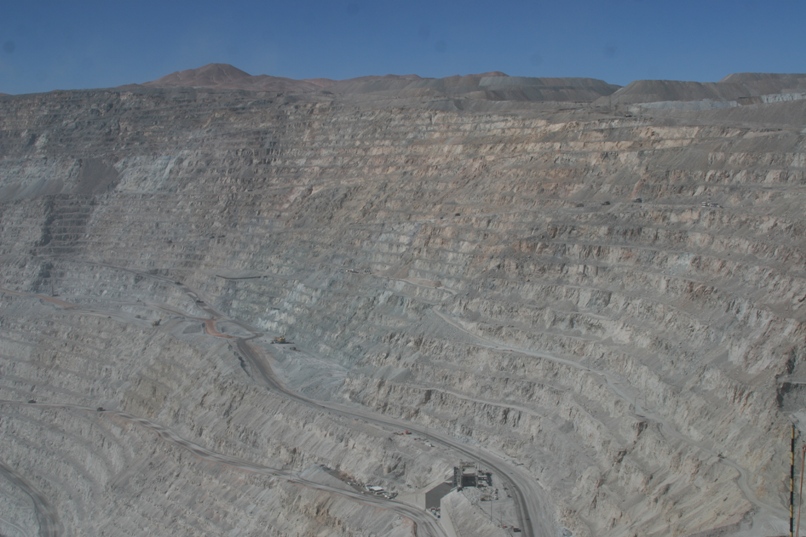
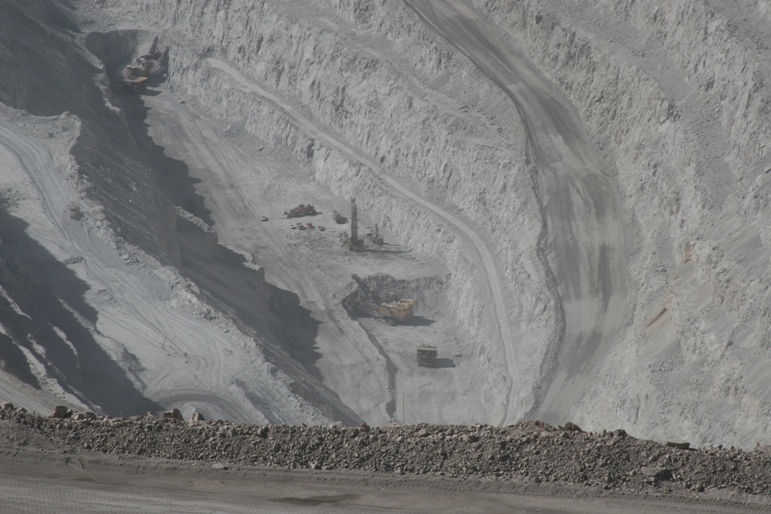
I wonder if there is something in our house with copper in it that came from this here hole? How about some of the electrical wiring or one of the assorted pennies lying around. I think the answer is most likely... yes!
Tomorrow it's off to San Pedro de Atacam we go. This is where "all the tourists" go, so our guidebooks warn us that after spending time elsewhere in the Norte Grande, we may be surprised by the density of gringos in San Pedro. I expect there must be something truly special that attracts the tourists. We're all counting on it!
-Rolf