Putre Parque Nacional Lauca
Amazing Scenery, Incomparable Place, Bad Advice
Friday July 27
Everyone struggled to get out of bed well before 7am Tuesday morning. If your bladder is not screaming, what's the point of crawling out from under a heavy pile of blankets into a frigid room before the sun has shown up for work, when you yourself don't have to go to work or school? Our point was that we had an an appointment with a local guide who was going to accompany us into Parque Nacional Lauca. The guide is a native of the USA, having lived mostly in Alaska before visiting Putre and deciding to stay a dozen or so years ago. Barbara knows the local birds, plants, community, culture, and history. She speaks reasonable Spanish (or more importantly, understands the Chilean speed-mumblers), and even better English. We had arranged via email to pick her up at her house at 8am, mas o menos.
Because of the early tour, I asked the hotel manager if we could have breakfast a little earlier than the 8:00am normal start time. He reluctantly agreed to 7:30. After coaxing, urging, de-blanketing, and whisper-yelling at the kids we were ready to eat by 7:40. The hotel lobby, dining room, and kitchen building was still locked and dark. At 7:45 the manager and and his breakfast helper rode up on bicycles, and scurried to get some hot water and toasted bread out for us. We ate quickly and were able to arrive at Barbara's place shortly after 8am. We surprised her with our arrival, less than 10 minutes "mas," as she was certain we'd be much later. Prior experience with families with kids led her to believe we'd be at least a half hour late. I don't know why we worked so hard at being on time, but I suppose being different from the "normal family" is a consolation of sorts. Barbara told us that unlike birding in a tropical jungle or temperate forest, there was no point in starting at daybreak in Lauca. "The birds don't come out or start doing anything until the sun warms things up, which is typically between 9 and 10am." OK, we'll sleep in a little next time.
We drove a steep, twisting 30-some kilometers further east from Putre to reach the boundary of the park, and in so doing gained an additional 3000 ft or so of elevation. Lauca is famous for many things, the least of which certainly isn't the spectacular scenery. Knowing that Geoff is a bit of a birder, Barbara focused on helping him/us spot all the local species, especially those that are rare and/or difficult to spot anywhere else.
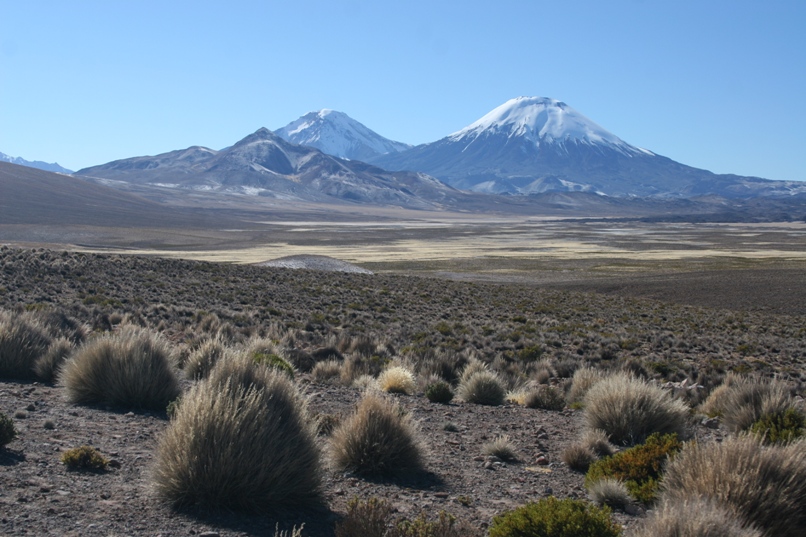
Shortly after passing the entry signs (no kiosk, no gate, no need to pay!), the park's three prominent volcanoes came into view. These are the twin dormant volcanoes Parinacota (the tallest) and Pomerape, and the more distant, active volcano Guallatire. In addition to the big three, there are other dark, semi-circular calderas adding to the rugged contour of the park - remnants of several more ancient, collapsed volcanoes. Barbara pointed out faint wisps of steam rising from the upper right flank of Guallatire (as an aside, Lynn has read and informed me that Chile has more active volcanoes than any other country in the world...). Although the last big eruption of Parinacota is estimated to be 8000 years ago, it must have been a monster. Giant rubble heaps of lava boulders created by this eruption are scattered prominantly across the landscape for 20 kilometers.
Pomerape (left) and Parinacota (right)
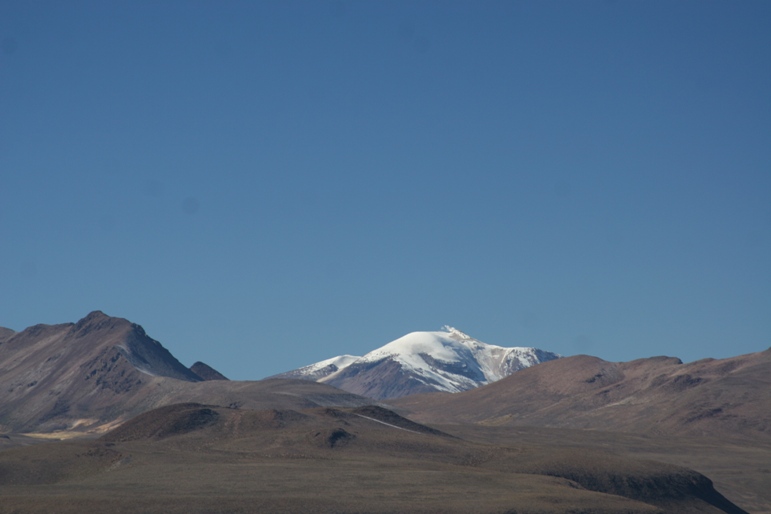
Guallatire (the active one)
Barbara reviewed some basic Andean geology with us - how the Nazca plate confronts the Brazilean something-or-other (shield?). The two pieces of the earth's crust pushing from either direction makes a sharp escarpment on both eastern and western flanks, with a big flat table in the middle. The flat part in the middle is the altiplano, and we were on it. This plateau is as high as the top of Mt. Ranier, with even taller volcanic mountains forming a jagged brim. I find it amazing to think that the earth's crust must be so thin at such a high place, but what else could explain an active volcano with a base elevation of over 14,500 feet? The immense pressure created by these sumo-wrestling tectonic plates creates molten hot-spots. Or something like that.
We stopped to walk around a little and spot an "important" bird at a place known as Las Cuevas. We saw many birds, but not the main target. We'll have to try again later. Perhaps the most enjoyable sight was the over-sized chinchilla/rabbit-like rodents called vizcachas. They hop around on their back feet, steering with their tails like miniature wallabies, and then sit bolt upright with their ears up and front paws dangling like big fat bunnies.
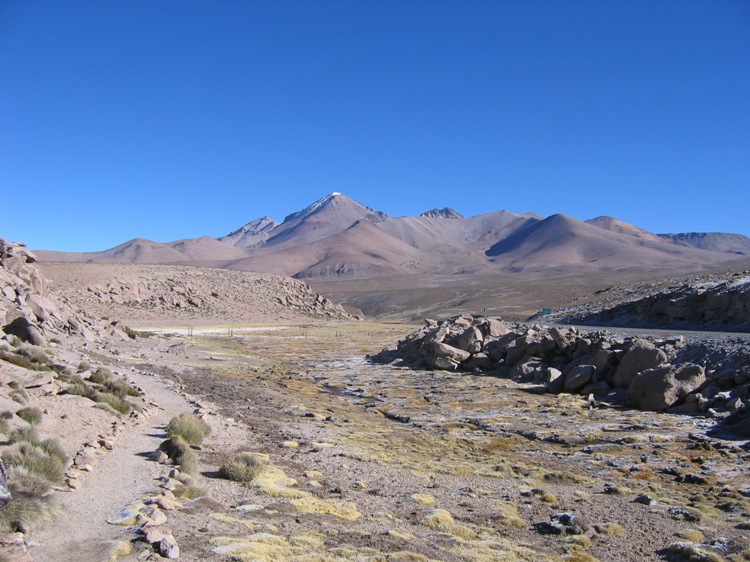
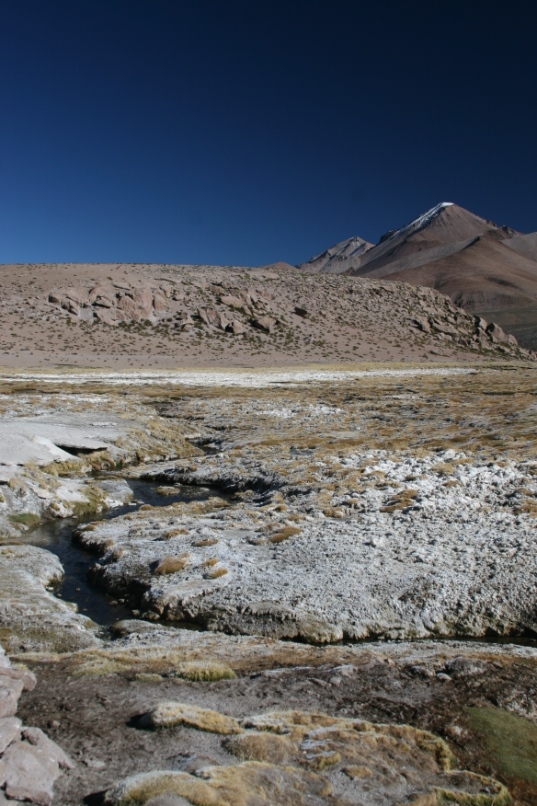
Scenery from Las Cuevas.
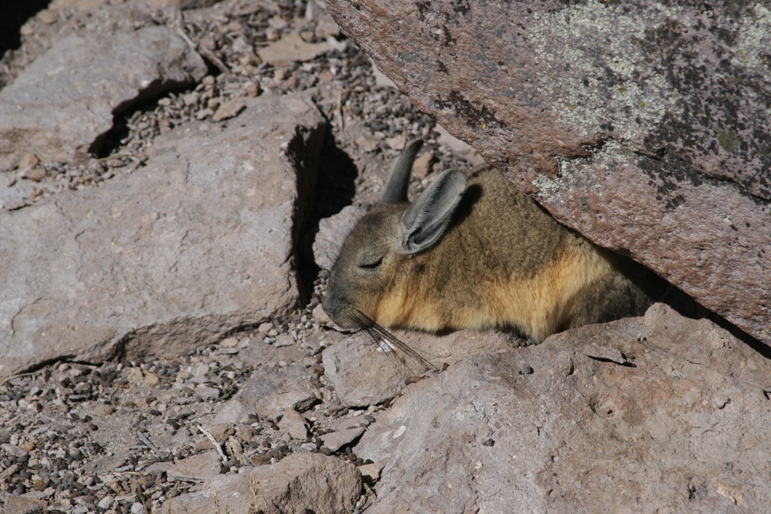
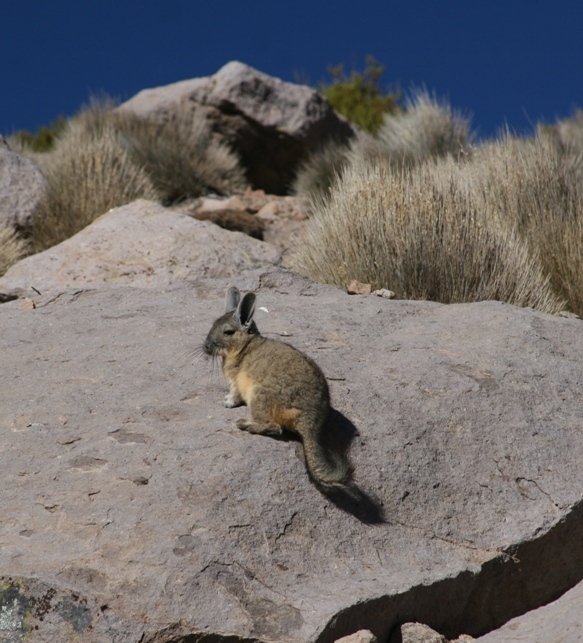
Vizcachas.
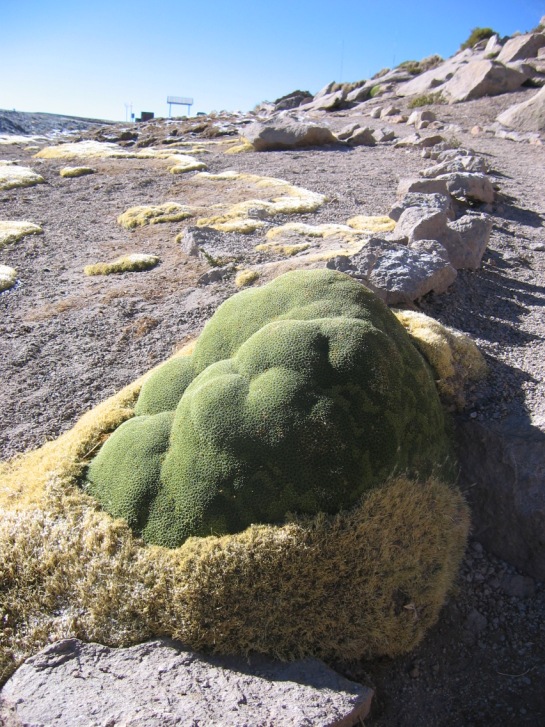
This spongy looking green plant is actually very hard and woody under the outer foliage. It can be burned, hence is/was an important fuel source for Aymara people living in or near the altiplano.
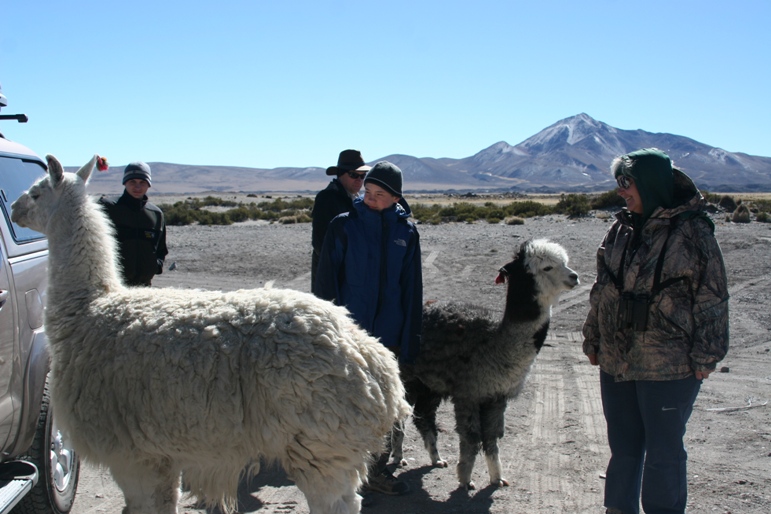
A "tourist" llama and alpaca looking for a handout at a bathroom stop.
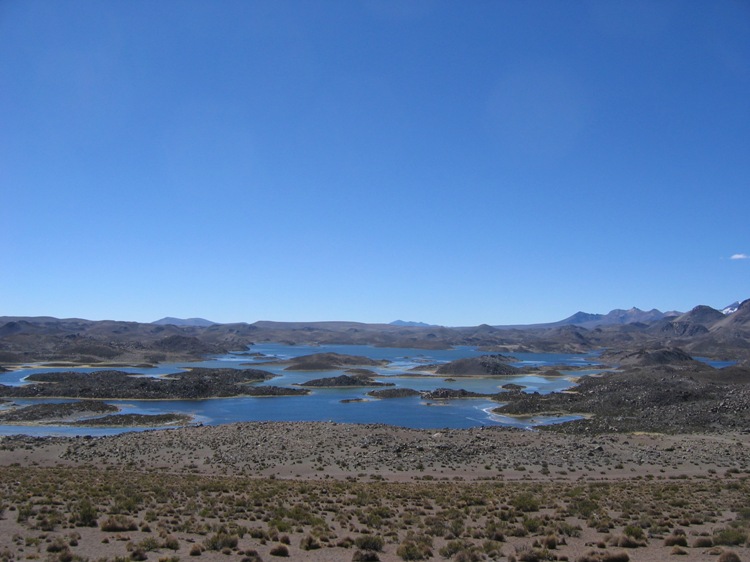
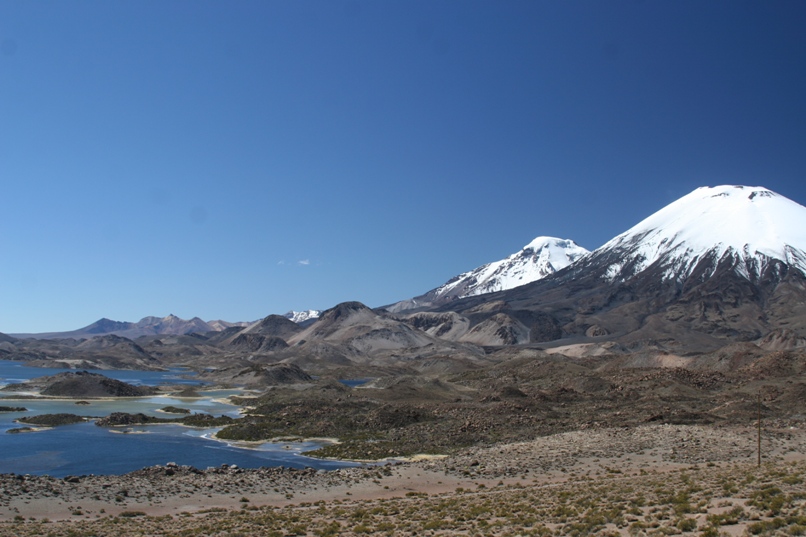
The piles of lava boulders also known as "Debris Avalanche" near Mt. Parinacota. The water feature is called "Laguna Cota Cotani," which is a mixture of Spanish and Aymara words. If you translate literally into English, it means "Little Lake Little Lake Lots of Little Lakes."
Assorted birds of the Altiplano. It freezes every night of the year, so survival is a nightly strategy. Conversely, it warms up every day of the year, providing ample food and bathing opportunities every day of the year. It's a 24 hour arctic seasonal cycle.
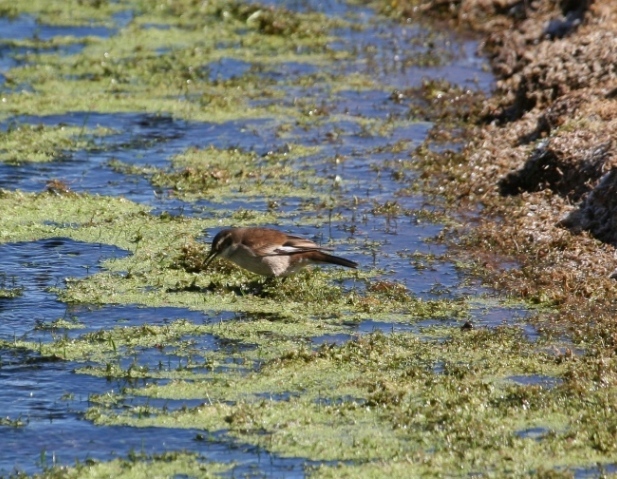
Cinclodes
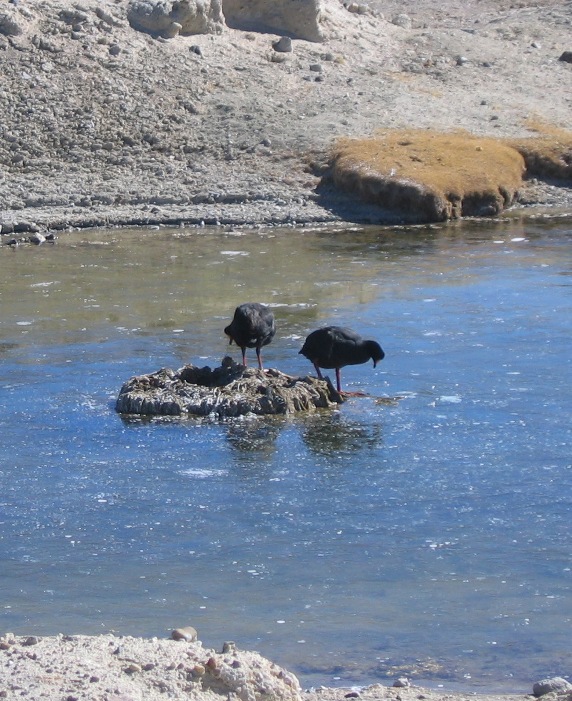
Giant Coot (on a nest)
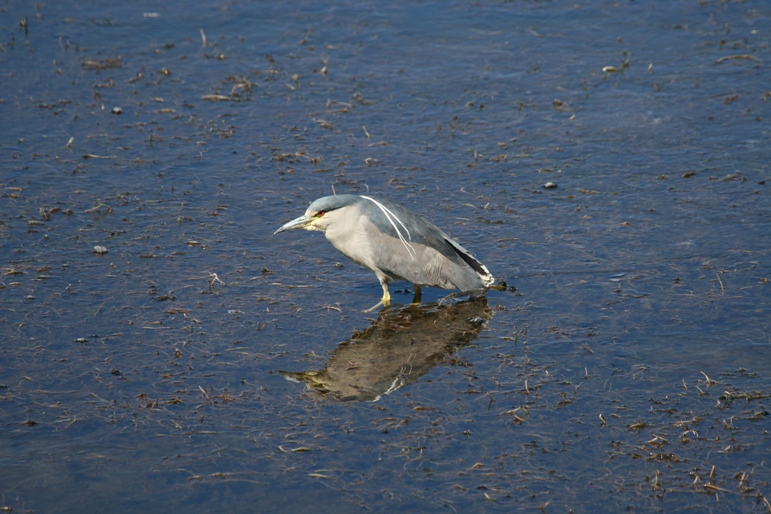
Night Heron (we see these all the time in Oakland - there is one that sits on the KFC sign near the Grand Lake Theater across from Lake Merritt.
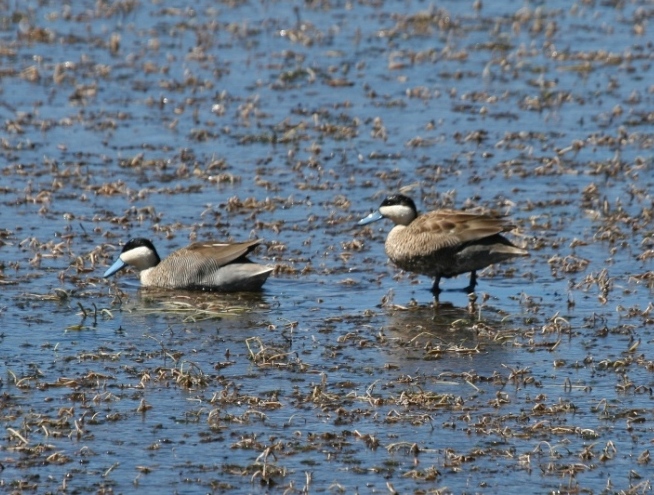
Puna Teal
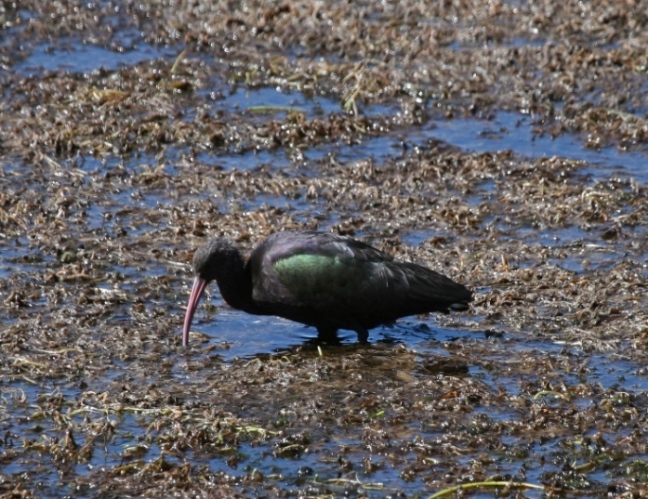
Ibis
Eventually we had birded our way to the banks of Lago Chungara. Chungara is one of the highest large lakes in the world. It is about 100 ft. deep at the deepest point, and sits at an elevation equal to the top of Mt. Rainer in Washington.
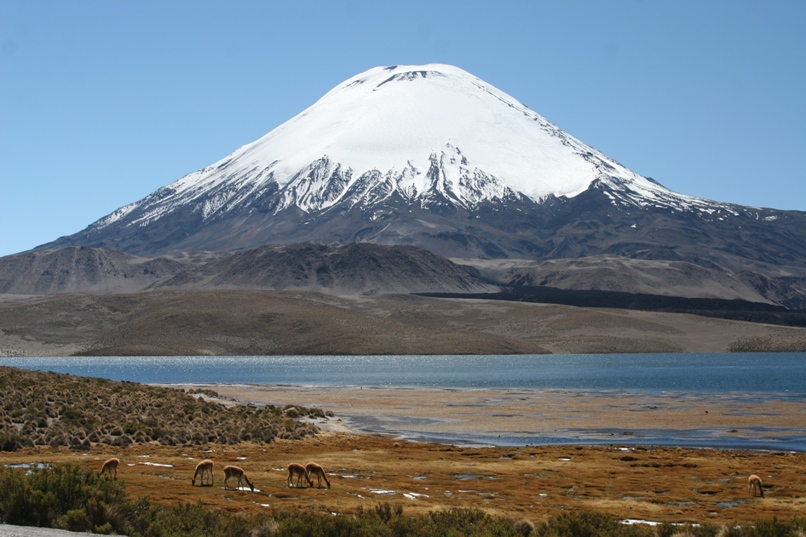
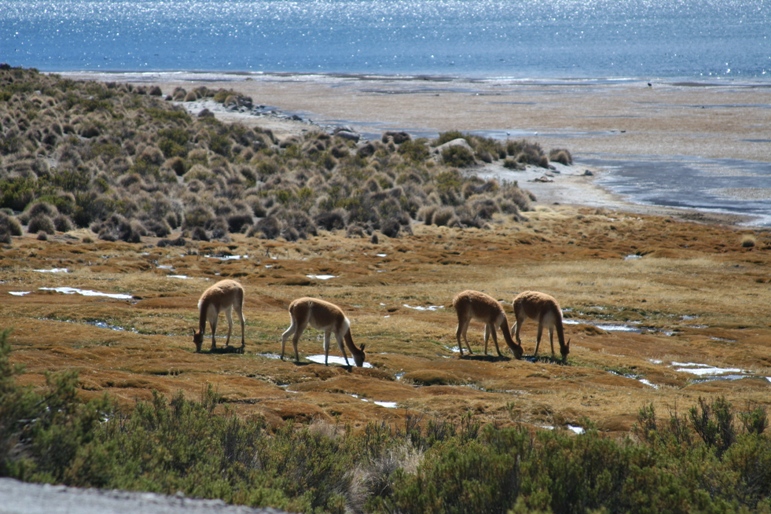
Vicuñas and Lago Chungara in the foreground of Parinacota
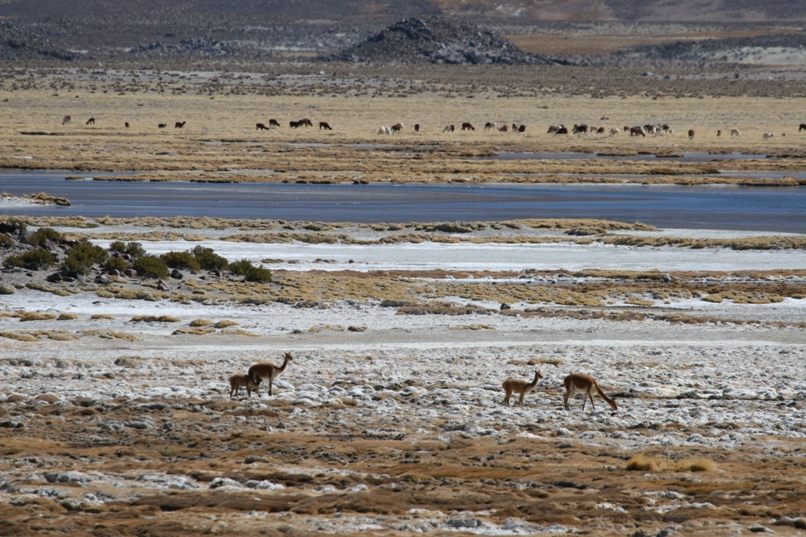
More Vicuñas
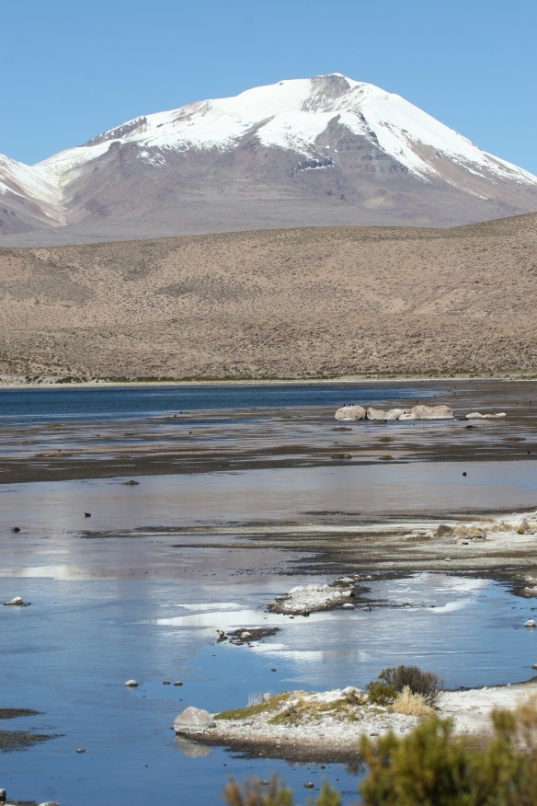
Reflections in Lago Chungara.
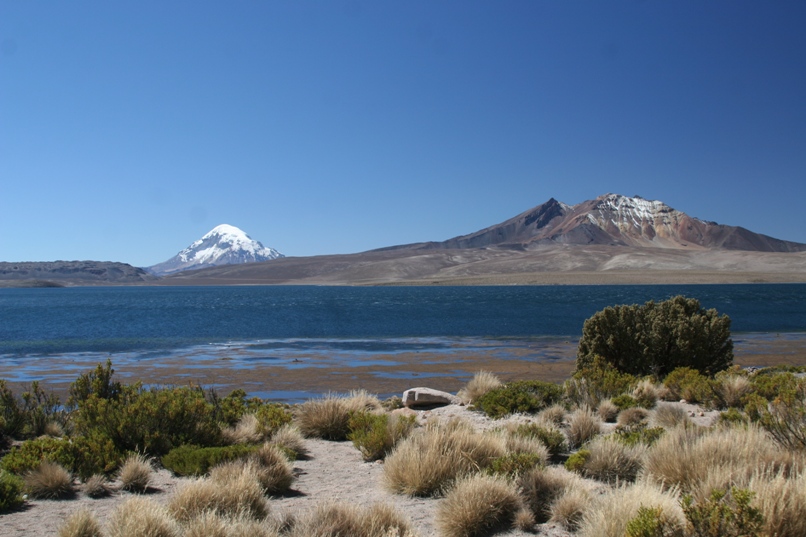
The snow-capped peak in the distance is Sajama, the highest mountain in Bolivia. At the far eastern end of the lake we were a just a few kilometers from the Bolivian boarder.
Four hours spent at 4400 meters elevation left everyone a little woozy, so it felt very good to return to Putre in time for a late lunch. Then we returned to our hotel where Lynn realized she couldn't find her wallet...
The rest of the afternoon & evening was spent on a semi-frantic semi-calm hunt for the wallet. The eventual reconstruction of the entire day in our mind's eye led us to be quite certain that she had, in fact, brought it with her on the trip into the park, and left it sitting in a slot in the car door. Almost certain that we had never left the car un-attended and un-locked (out of view), we tried to imagine how and/or where it could have been kicked out of or inadvertently taken from the car door. Barbara and I decided to retrace our drive while Lynn would tear apart the hotel room in-case she had imagined bringing it.
When we re-visited Las Cuevas, I remembered Barbara asking me to unlock the car so she could retrieve her spotting scope. She told me something like "You don't have to worry about the car here, no one will ever touch it and we can always see it - we're only walking a little ways down this path. I've been doing this for over a dozen years and there are never problems up here. It is totally safe. I don't lock up every single time we get out to look at things, and here we're only walking a short ways and we're parked right in front of the government office." So not knowing how far we really were walking from the car (ended up being about 100 yards), and tiring of everyone asking me to unlock the car so they could get or put something, and not wanting to seem like I didn't trust or believe her, I left the car unlocked and kept glancing back at it while we were watching birds and looking at a hot springs. I didn't recall noticing any traffic on the road the whole time, but now, revisiting this place, both Barbara and I remembered seeing a green truck (I remember thinking it looked like a military truck, so I didn't think much of it), leaving the parking lot as we walked back to the car. It the time, I didn't even know there was a valuable item sitting in the car (or I would hidden the wallet and locked the car no matter what Barbara had said), so I didn't think to check for it when we got back in the car. The rest of our collective haphazard mess looked un-touched and in place.
As amazing as it seemed (especially to Barbara), after re-visiting every place we had visited earlier in the day, the most logical explanation came down to a very sneaky, rapid, cunning removal of the wallet by the green truck inhabitant(s) while our backs were turned for 30 seconds or so - with the green truck parked on the far side of our truck so we never saw it. Still, we don't have proof as no one other than Lynn really knew her wallet was in the car at the time, and no one checked the door until much later after we returned from the park. Barbara was very apologetic and I didn't know quite how to deal with a 50/50 mix of indignant outrage at us having to pay the price for her learning NOT to tell her clients that it is completely safe up here in the park (it is never completely safe when there are other humans around!), and our own bumbling foolishness at leaving important possessions out in the open. After briefly considering the possibility of French Tourists being somehow culpable (after "some of the the things I've heard about them"), Barbara eventually concluded "Huh, it must be Bolivianos because we are so close - and now they'll have been back over the border for a long time. I just can't see them doing that, crossing over just to hit tourists in the park. There aren't enough tourists for starters. That's just un-imaginable. Well I'll tell all my clients from now on to lock everything every time, whenever we walk more than 10 yards from the car!"
I'm thinking but holding my tongue, "Gee, thanks for that great advice. I hope you appreciate what we're about to go through for teaching it to you."
So here we go again. At least we've increased our average time between theft or loss from two days to a little more than 15. I desperately hope the trend continues.
This time, for me, the deep anxiety didn't last as long as the pick-pocket experience in Santiago, probably because I had family around for sharing and support. But unfortunately, this incident will cause more trouble than the last, as Lynn's passport and California driver's license (both!) were in the wallet. Now we have a reason to drop in and say "hi" to the US Embassy staff when we return to Santiago. And now I am carrying my personal documentation papers more carefully than ever. I'd consider having them sewn under my skin with some sort of zipper if the medical technology existed and was both affordable and available to those of us not named "Bond."
Tuesday evening was spent trying to call the US to cancel some credit cards from the "Ciber Coffee" call center in Putre. The calls seemed to connect only 10% of the time, and when they did, the sound quality was so poor that the call center agent would often give up and hang up on us (after we had waited on hold for many minutes). We contacted our house-sitter Peter via email and he worked the problem from his end as well. Good news was that it appeared that no one was trying to use the cards for anything. I slept poorly, feeling all those familiar feelings from Santiago all over again, but this time it wasn't quite so bad. Now I had family near, and Lynn was handling the situation extremely well (not getting mad or blaming me - at least not overtly), which I appreciated immeasurably (and still do). She didn't even know about the "don't worry" comments from Barbara until the next day. I wanted desperately to ask her to tell me when she had valuables with her, but I know she didn't want to bother me "any more" (as I've already grumbled about so many people telling me to get this and get that and unlock the car and relock the car and remember this, etc...). All hindsight now.
Wednesday we took Geoff along to visit the carabineros in Putre. Our story drew the attention of the entire office staff, and they consulted amongst themselves for awhile before deciding to march us over to the government offices where the mayor and governor work. Here we sat on couches in a waiting lounge along with a fluffy Husky dog who solicited our affection with wags and by laying his head in Geoff's lap. After a few minutes, a member of the office staff took us and our carabinero escort into the office of some important person, who asked a few more questions. After a rapid-fire consult with the carabinero, he seemed to have come up with a solution. First, we were to return to the carabineros to write up a formal report. It must say "lost" and not "stolen," because to report a theft would require us to drive 120 kilometers and 11,000 ft downhill back to Arica. With this report in-hand, we would then return to the same guy's office and he could write up something called a constancia, which was an official declaration by the local governor's office stating that Lynn had a legal write to be in Chile until her return to Santiago where she could obtain a replacement passport. With this constancia, along with the photocopy of her passport which had been stored outside of her wallet (finally, we did something right!), we'll avoid problems for as long as we are traveling in the north. We hope.
We went back, filed the report (watching over the shoulder of the guy typing), took a copy back to the government office, watched while the guy there typed up the constancia, and eventually had the coveted document in hand. The whole process, start to finish, took about 2 hours. Long before the end, our carabinero escort had tired of formality and was asking us lots of personal questions and telling us about his brother who lived in Texas. He has plans to visit him next summer. We told him to look us up if he makes it to California (and we meant it!). He was a very nice man, but I don't recommend this manner of making friends in foreign countries.
On Thursday, we hired a local guide to lead us to some ancient rock paintings below town. We walked about 7.5 miles - slightly downhill on the way there and extremely steep uphill on the way back. It was literally more up than down, as we got a ride about 2 kilometers downhill out of town on the outbound leg, which had to be walked (all uphill) on the return. We were filthy and exhausted at the conclusion of the high altitude trek, but I think we were all in need of some good serious exercise - and a diversion from governments and police and dastardly Bolivianos.
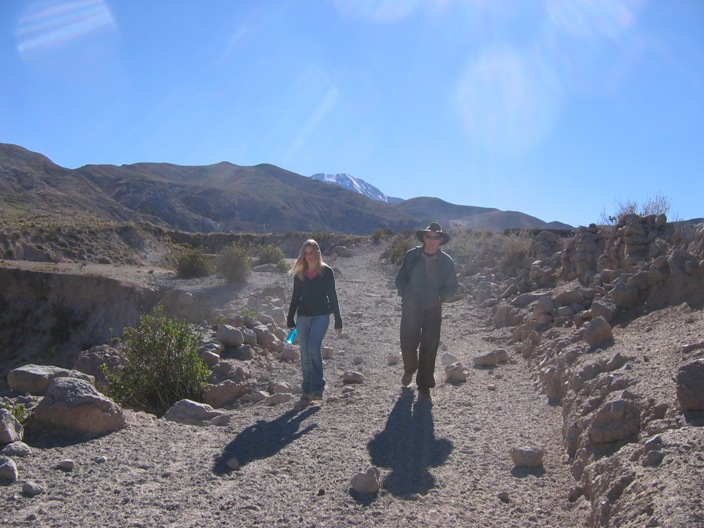
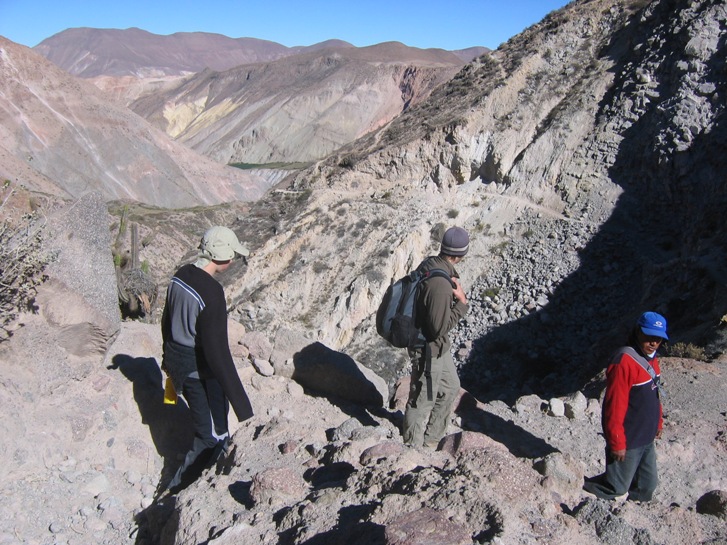
Hikers.
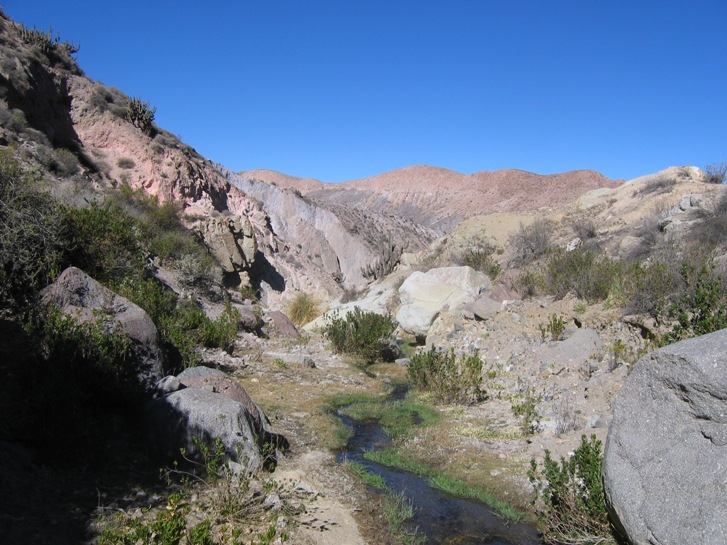
Lluta River.
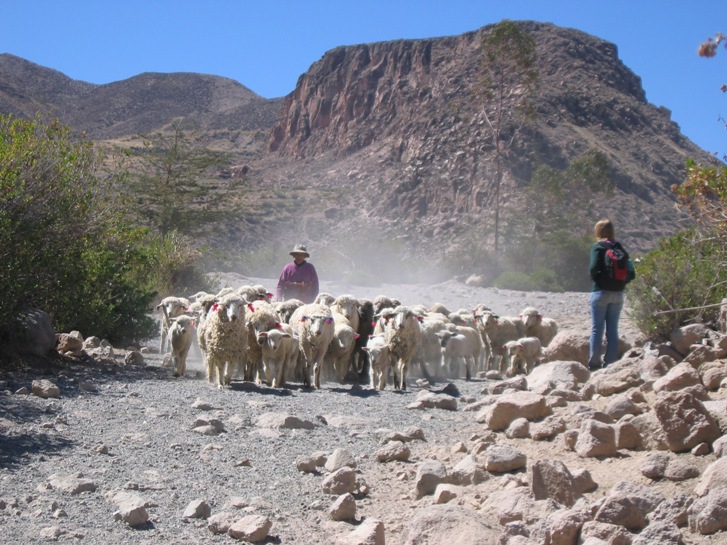
Make way for sheep!
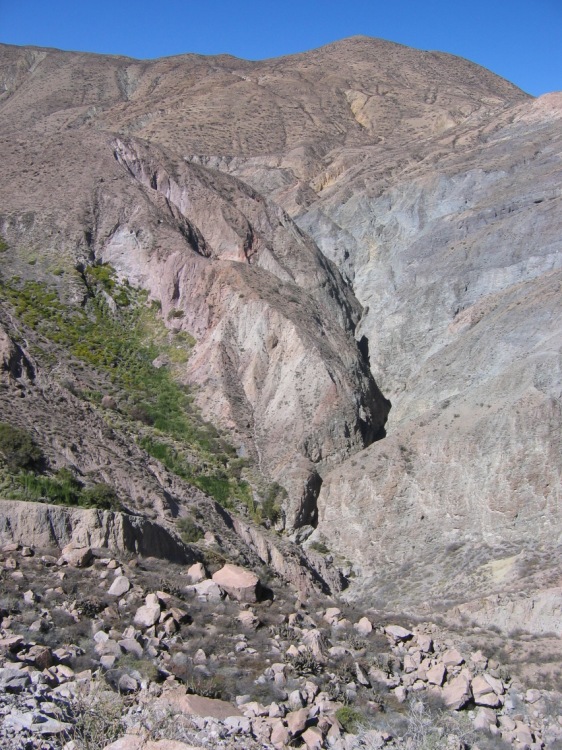
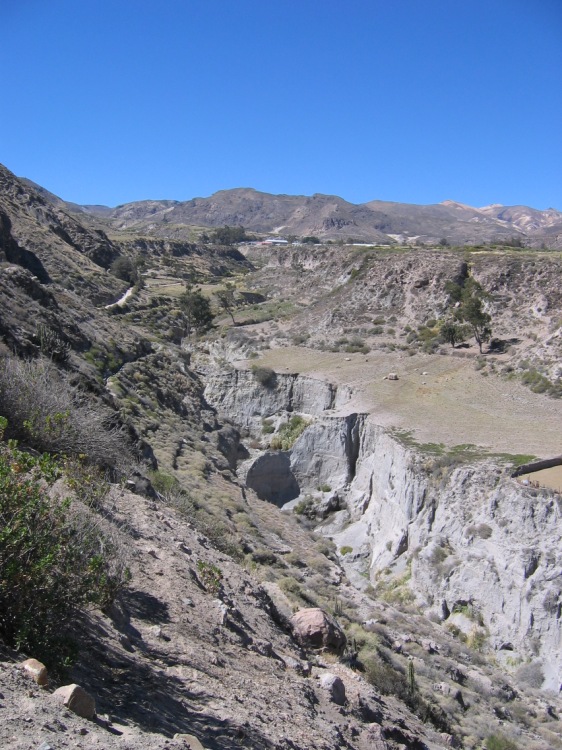
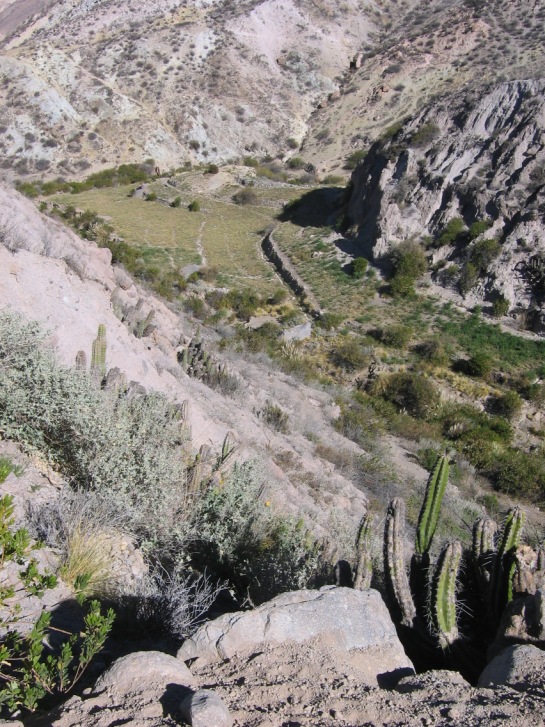
Views of the Lluta valley (canyon).
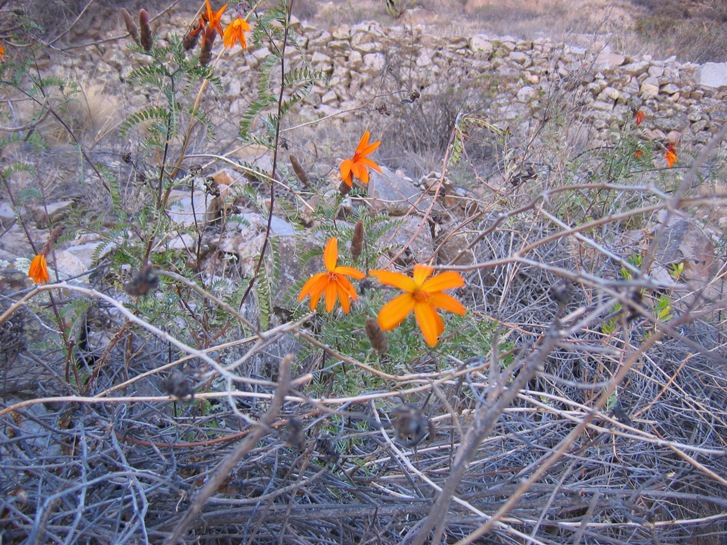
Desert flower of undetermined species.
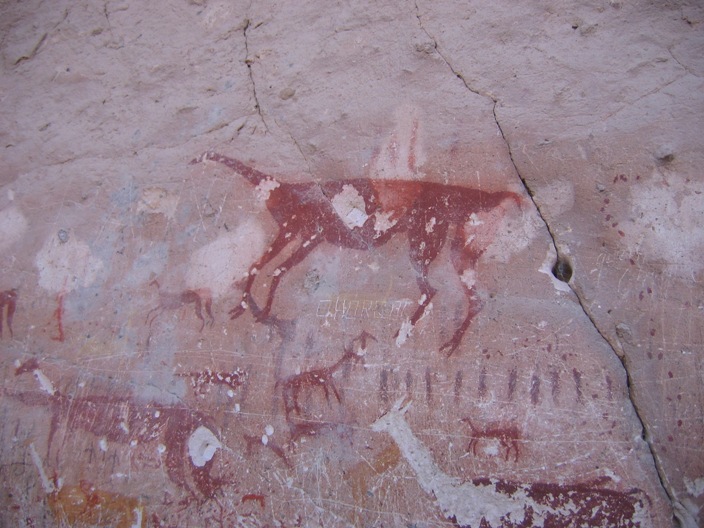
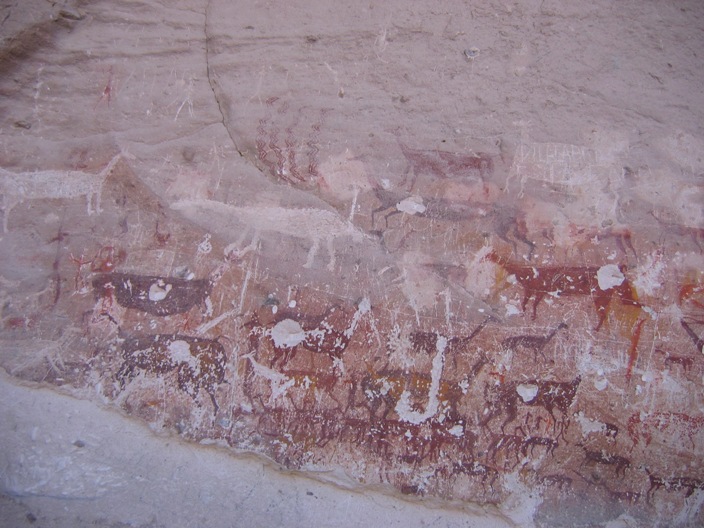
The target of the hike - rock art painted somewhere between 4000 and 6000 years ago. The recent defamation is not so attractive, and there is nothing protecting the paintings.
Today was and excursion similar to Tuesday's, although more secure for sure. Barbara accompanied us into Parque Lauca to help Geoff spot a few more difficult to find birds, and then we went to the old village of Parinacota. First we visited the school, and then toured the ancient church in Parinacota.
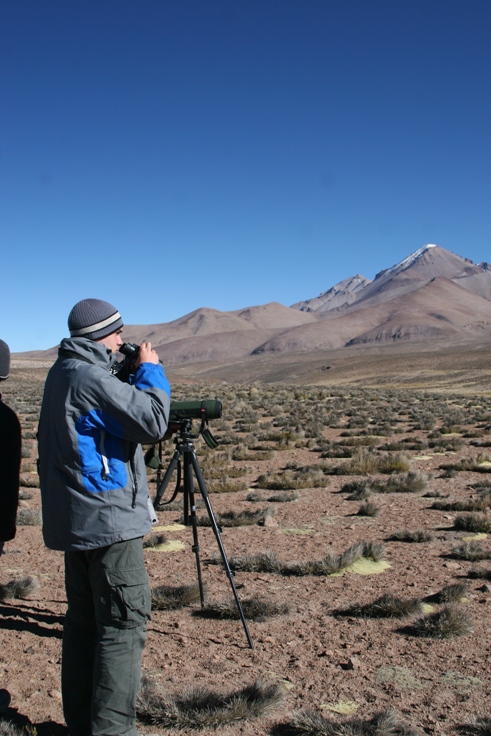
Geoff hunts the Seed snipe.
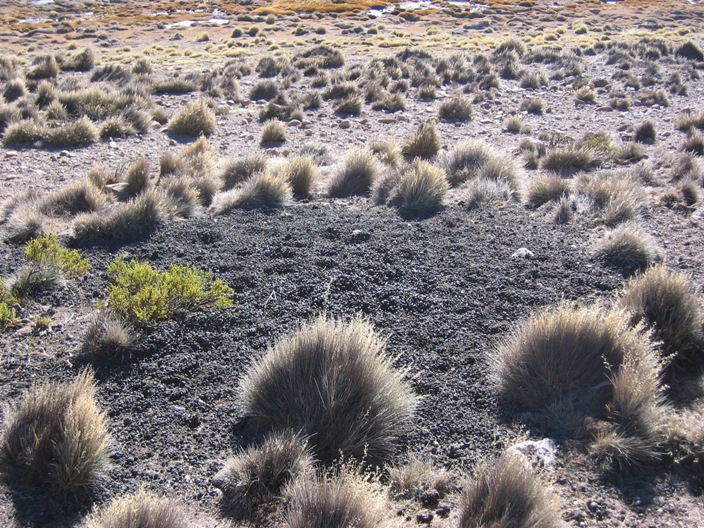
Vicuñas use communal toilets
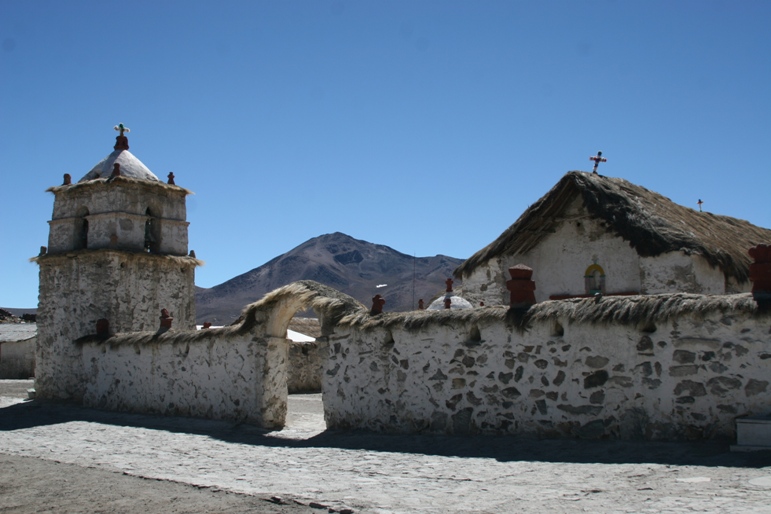
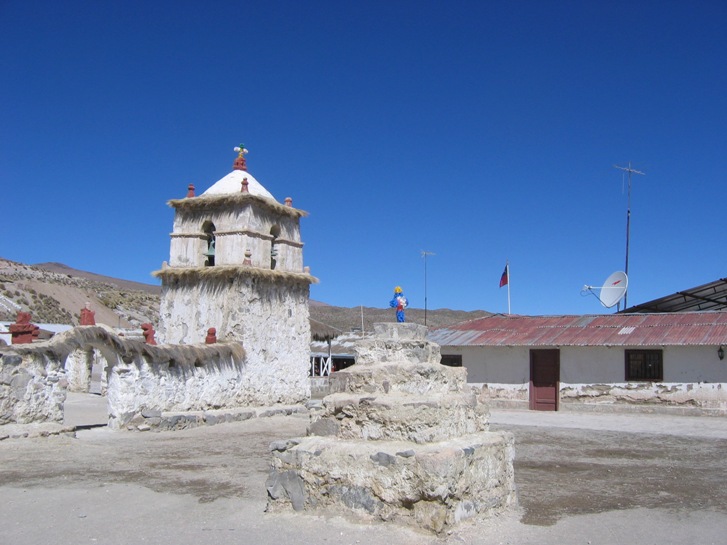
The church in Parinacota Village - built in the mid 17th century, toppled and reconstructed several times by large earthquakes.
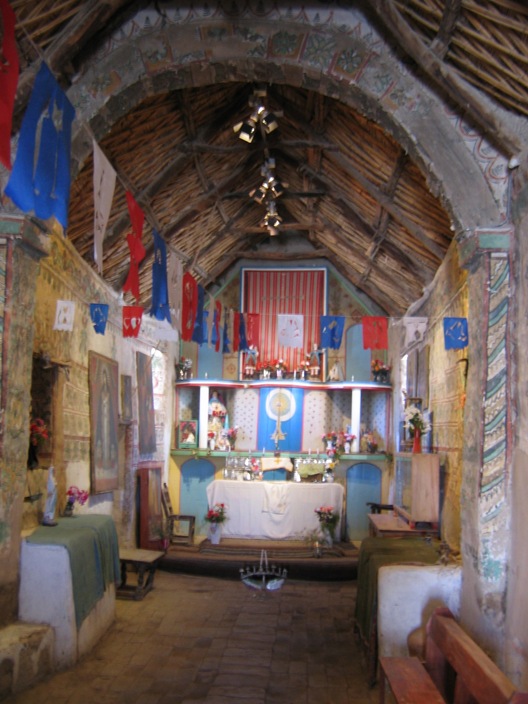
Altar inside the church.
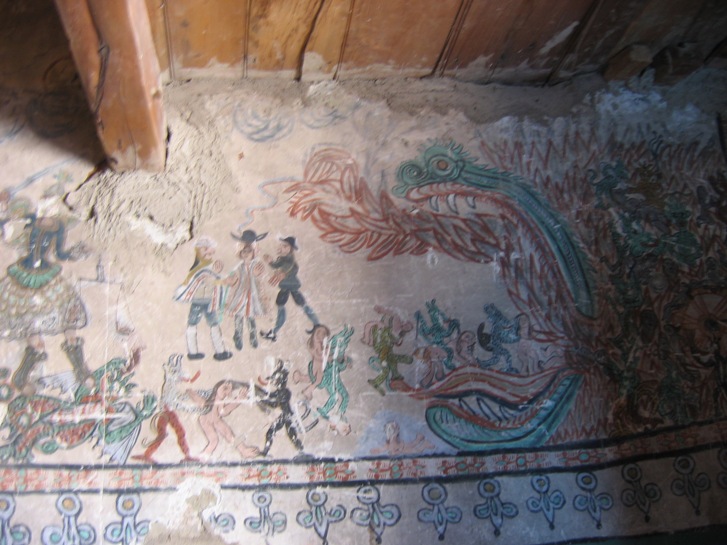
In spite of the earthquake damage through the years, some of the original murals remain intact and unaltered on the upper walls of the church. This scene depicts judgment day.
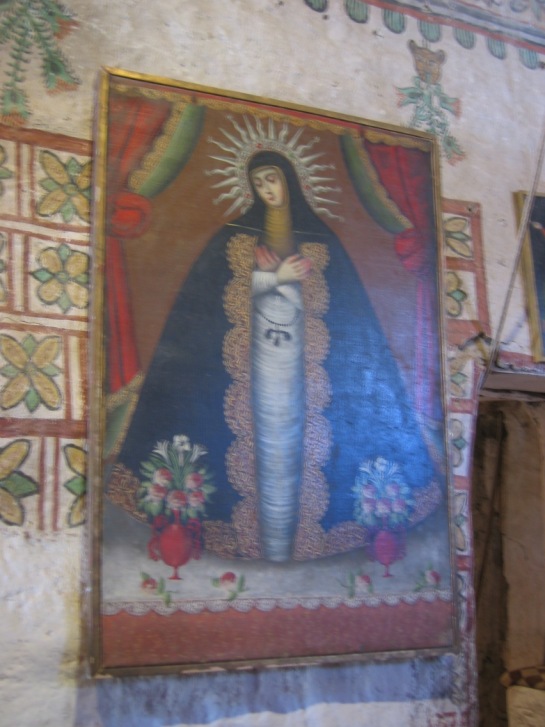
Painting made by a local native in the style known as "Andean Baroque."
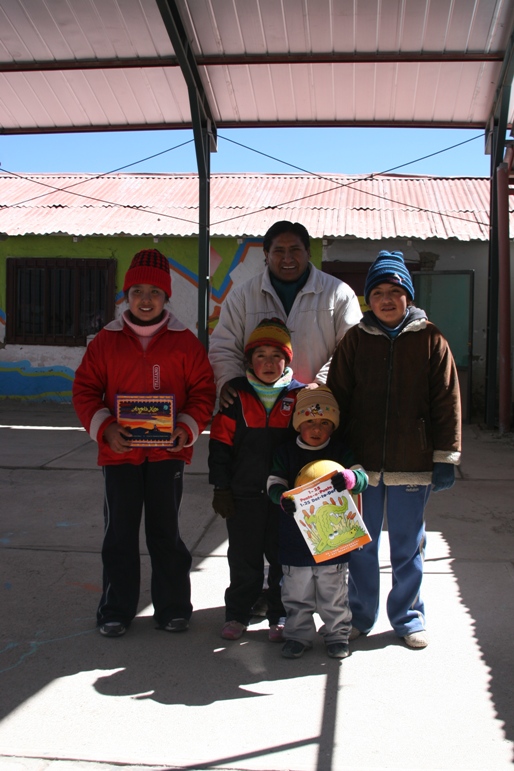
We visited the school and gave the students a few books. The proud headmaster, "el profesor," told us that he now has 8 students, but only 4 were there in school today.
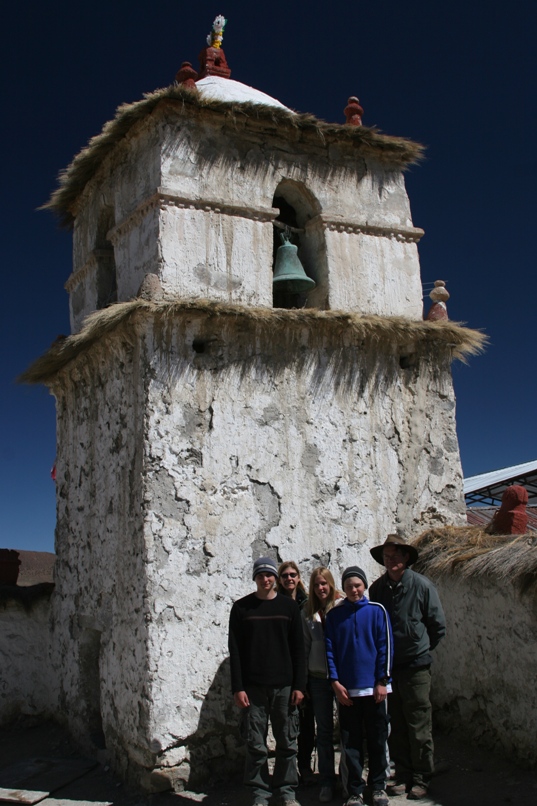
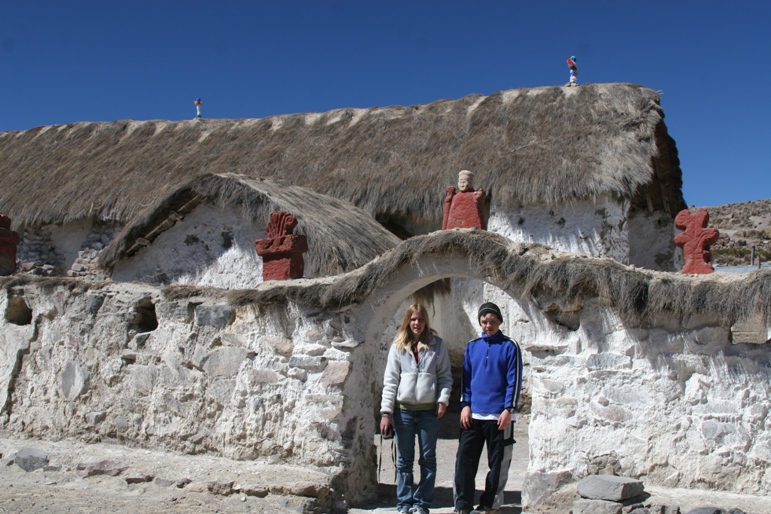
Family and Tom/Anna shots near the old church.
Somehow the day passed with complete cordiality and a total enjoyment of Barbara's services, and any lingering resentment just didn't seem worth bothering with. Now we've eaten our supper, shopped and pre-packed for our departure tomorrow, and everyone is sleeping except for me. We'll be heading south to Parque Nacional Las Vicuñas, where we'll stay at a CONAF (Chilean National Forest Service) refugio (primitive lodgings). We have to carry all the food and water we'll be needing for the next two and a half days with us, not to mention plenty of blankets, good sleeping bags, and warm clothes!
-Rolf