San Pedro de Atacama
Marsscape, Geysers, Hot Springs, Bad Roads.
Thursday August 9
Warning Warning Danger Danger. Rambling journal entry follows. Skip to pictures if you aren't interested in mundane details of the life of a traveler!
************************************************************************
Tuesday evening Lynn and I enjoyed some quiet time together. Anna was still recovering from her migraine and the boys were content with the digestion-still-in-progress from their huge, post horsy-ride lunches.
We huddled with our backs to the open fire in a small restaurant off the zona peatonal (tourist pedestrian zone). The waitress reported that they had a large selection of fine wines, but nothing by the half bottle. At her suggestion, we agreed to try the half liter of vino de la casa for $4, which was served in a large Pyrex measuring cup filled precisely to the half liter mark. Halfway through our meal of soup and cheeses, she showed up with another large measuring cup full of wine. She was astounded and slightly disappointed when we refused the additional dose of purple basting fluid, even after we insisted we understood that she understood us and that she could trust that we understood the meaning of "gratis" (who in their right mind would refuse free alcoholic grape juice served from a measuring cup?). We just can't keep up with those French tourists who down a few pisco sours as an appetizer before starting in on the vino. For us, 500 ml of precisely delivered vino de la casa is plenty.
Regarding French tourists - and British, and Swiss, and German, and even real Spanish ones from Spain - there's a lot more of them here than Americans. The day we arrived we sat next to a few American college students at lunch, but in general the English we hear spoken is rarely American accented, and when it is it comes from young people. The middle-aged tourist adults, both solo and/or families with children, are virtually all European, as are the majority of the young-adult tourists as well. Lynn and I shared this observation, along with some questions and theories about it during our dinner date.
The United States is closer to Chile than Germany or France are, isn't it? Does the strong Euro and British pound make foreign travel that much more enticing for the Europeans? Does the fact that Europeans typically take month-long summer vacation have something to do with it? For typical workaholic Americans who needs to cram a luxury vacation into 1-2 weeks, a 1.5 day travel time to get here from a major US city is a big deal I suppose.
It isn't expensive to visit SP de A if you're willing to stay at one of the many simple hostels or hosterias that are basically safe and sort-of clean but don't have heat at night. Our hotel is "upper end" (meaning it has heat at night), but isn't nearly expensive as the luxury resort that's located on the outskirts of town, provides all meals and expedition-guide services, and costs about $600 US per night per person. All the other guests in our hotel (and everywhere else in the tourist heart of town) speak French, Spanish, or British accented English. The Spanish tourists from Spain are easy to spot - they pronounce words clearly when they speak and we can understand them!
We can reason why we're not stumbling into American adults and/or families, but our logic doesn't explain why the young adventurous youth of America aren't here. Maybe Chile doesn't get much publicity in college towns across the USA. I'd hate to think that the youth of America is as soft as their parents, and that the rugged hippie adventure spirit is almost completely gone from American culture. It is indeed slightly rugged here, but in a very hip, cool, sow-your-wild-oats sort of way. Packs of European almost-adults are diggin' on it for sure. Maybe the Europeans came here to get away from the Americans that are crawling all over Europe right now.
Here in San Pedro de Atacama, many of the more economical restaurants have no heat at all (just like the economical hotels), and you have to live the life of a local if you spend time there after dark. This means you wear coats, or shiver, or both. At 8000 ft above sea level in the tropics, it is very warm during the day, and very cold at night. The natives don't bother with heat in their own homes. It's just too darn expensive. Firewood means chopping up your neighbor's rotting fence. They don't bother with insulation or plugging up cracks in the walls or under doors or in window frames, either. They just put on a coat and hat and sleep under lots of blankets and ignore the temperature until the next morning when everything heats up again.
The French, Germans, and British just put on thick coats and drink more wine and beer. The Americans just aren't here (apologies to the few brave young American backpackers who are here - I hope you're having a good time!).
Perhaps this place just isn't worth the trouble to get to and suffer through cold nights in when you have Yellowstone and the Grand Canyon and Yosemite and Disneyworld (etc, etc...) in your domestic back-yard. I enjoy the fact that we're not running into other Americans everywhere we go, but I wouldn't mind chatting with one every now and then. I haven't had the luxury since talking to that Pakistani-family-from-Houston back in Santiago. The local Chilean newspapers dutifully keep us abreast of the latest on the Paris Hilton/Jessica Simpson front, and the internet headlines tell us about the stock market and the Minnesota bridge collapse, but sometimes we can't help but suspect something else of interest might be going on as well. Isn't there some sort of election happening soon?
*********************************************************************
El Travelogue empieza siguiente....
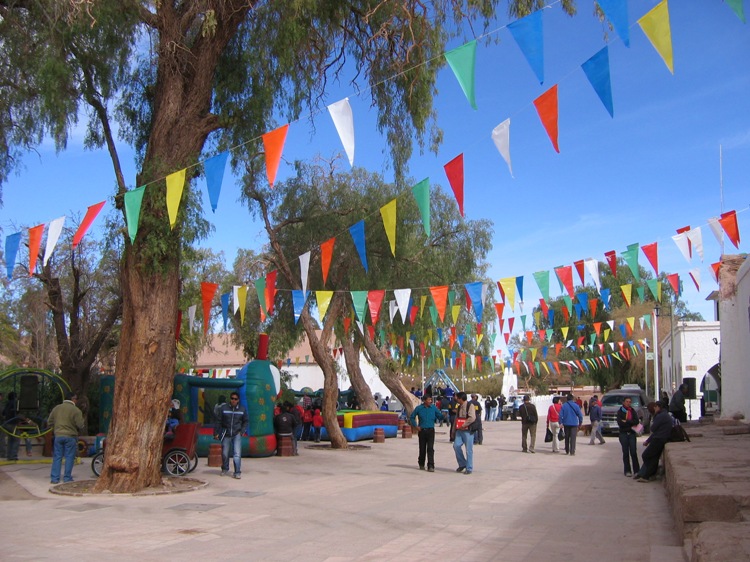
Wednesday we hung out in town most of the day, but braved gusty winds in the late afternoon to visit the nearby Valle de la Luna. In the morning we walked through a festive plaza to get to the museum, where we learned a few interesting facts about why people have chosen to hebetate this harsh part of the planet.
There was some sort of party for school-children going on in the plaza, which gave the whole city a festival air.
Now here is what the museum had to say (paraphrased by me):
Apparently, the high-altitude South American altiplano was much wetter shortly after the last ice-age. This meant more fresh water, more wild mammals, more vegetation, and essentially more of everything a hunter-gatherer type of pre-historic human could want. But eventually the after-effects of the ice-age dried up, and there was a great drought (after people had been living here for a few thousand years). Now what to do? Adapt, move, or die. Undoubtedly, there was a little of all three involved in the evolution of the local communities of humans. The museum tried to explain what most likely transpired with a lot of archeological conjecture and a sequence of window displays featuring ancient bone, rock, wood, and metal paraphernalia.
The former fantastic morbid attraction of this museum - "for-real" locally excavated mummies, has been removed just a few months ago. The local Aymara community had been griping about the museum displaying the dead bodies of their ancestors for the entertainment of tourists, so the museum finally capitulated and took them off display. Good for them. We really don't need more mummy photos anyway.
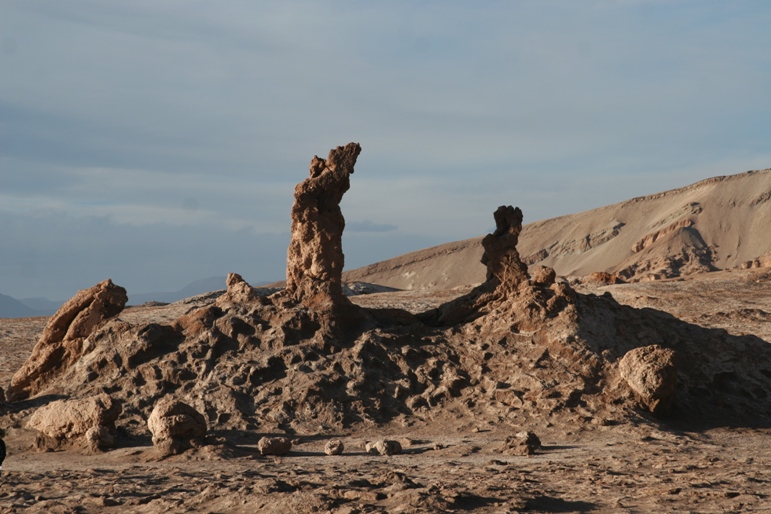
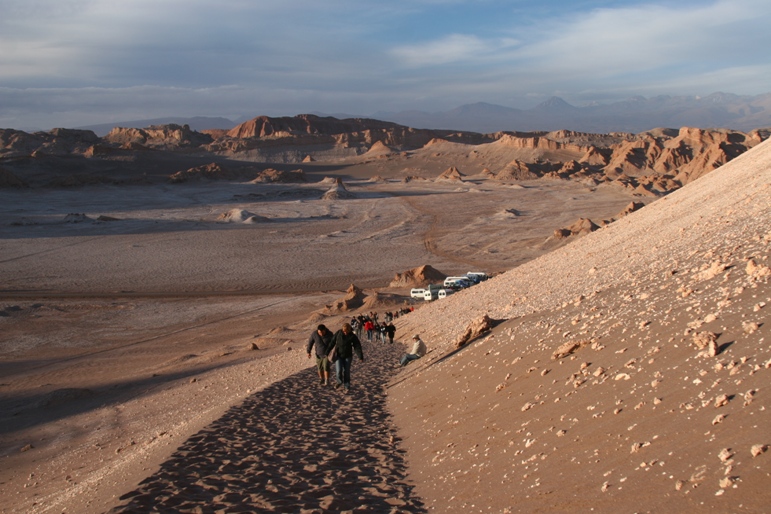
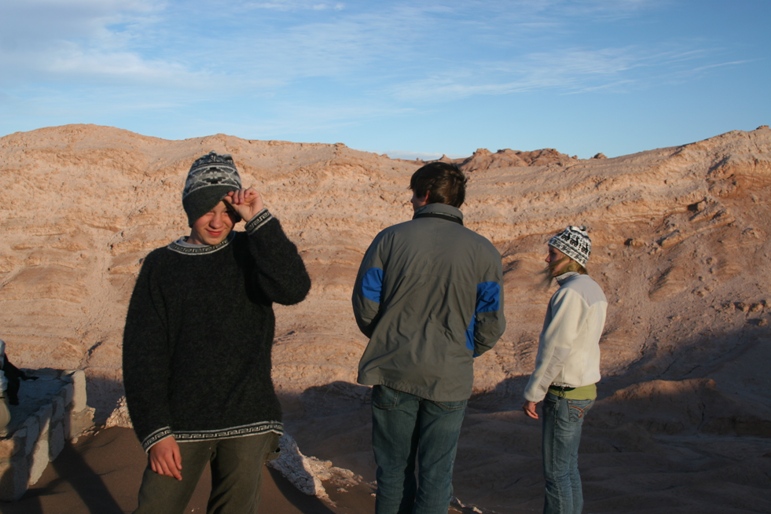
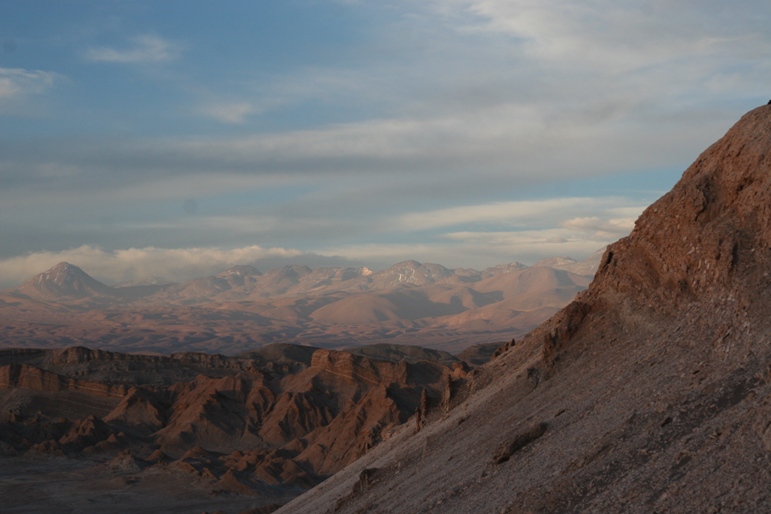
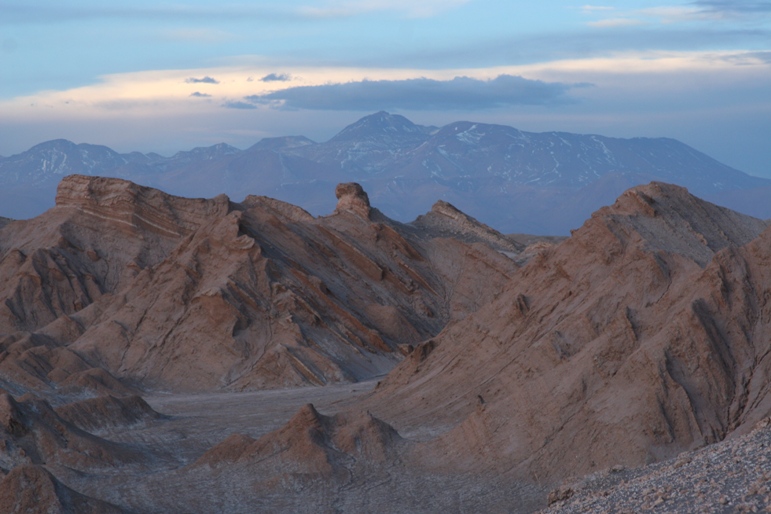
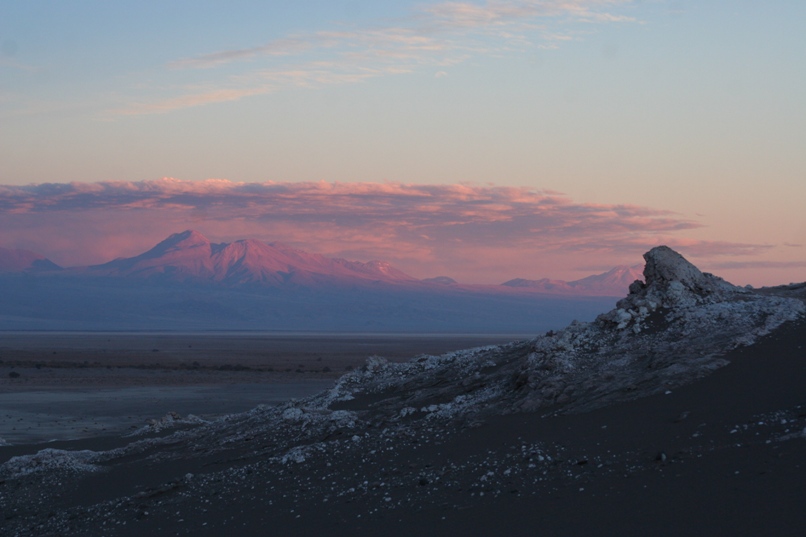
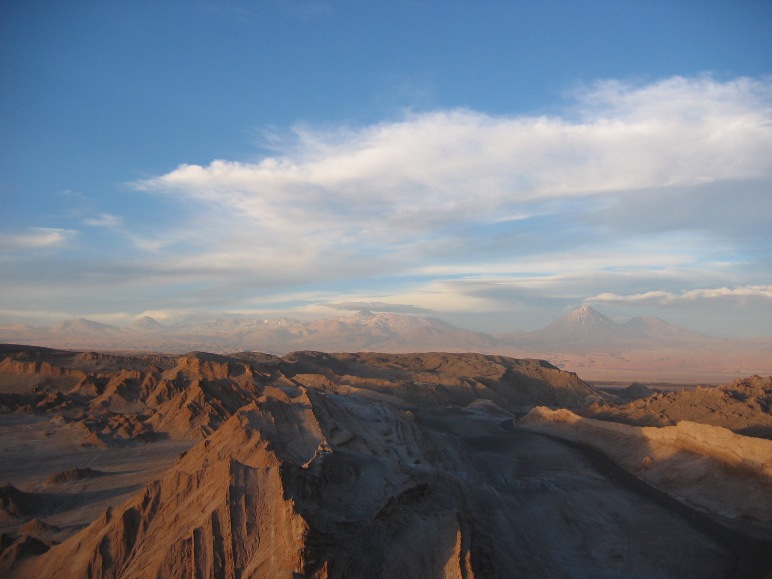
After lunching at the "Empanadium,", we "relaxed" (did schoolwork) until it was time to fetch the truck and drive to the Valle de la Luna for a late afternoon viewing. Valle de la Luna (Valley of the Moon) is a de-rigueur tourist destination for the San Pedro de Atacama visitor, and many lucky stay-at-home relatives will receive a post-card with some fantastic photo of this other-worldly piece of planet earth.
Personally, I think it looks more like Mars than the Moon, but I've not physically been to either. We were hoping for dramatic sunset views, which we got, but I think they could have been even better. High clouds shadowed the volcanoes so they weren't as dramatically lit by the setting sun as they might have been. Still it was pretty awesome.
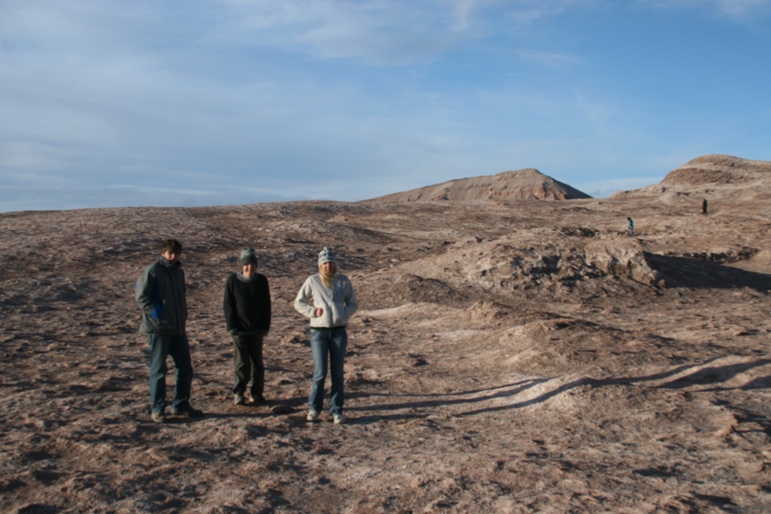
Walking on, walking on the moon...
********************************************************************
Thursday we all got up at 4:30am in order to drive 100km north to see the world's highest elevation geysers at El Tatio. Lynn had read about the trip in a guidebook and suggested that we might want to sign on with a tour company. The receptionist at our hotel told me we'd have no trouble driving ourselves (having seen our fine 4x4 truck). Smelling the chance to save a couple hundred dollars, I took her word for it. By 5:00am, we were on the road. The first 10 minutes passed smoothly. Then the road became sharply corrugated and started climbing steeply through some sort of mountain pass that we couldn't really see in the darkness.
The rest of the 2 hour drive chattered our teeth and shattered our nerves. We could have just driven really slowly and not shook so much but the guidebooks told us that the geysers are only active between 5-8am. So like the tour company mini-vans, we had a deadline to meet. In the end, we made it to El Tatio shortly after 7am with plenty of time to spare. We even beat some of the tour company trucks and mini-busses. At 8am sharp, the geysers did NOT abruptly turn off - we could have slept in for at least another half hour!
Our guidebooks also have pictures of smiling people enjoying the hot springs at Termas de Puritama. These termas are located near the road to the geysers, so we had planned to soak in them on our return trip. Our guidebooks did not tell us that the water in these termas is only 94 degrees Fahrenheit (or 4 degrees below normal body temperature). On a nice warm day in summer, this would be quite comfortable. On a chilly, windy day in winter, it's comfortable for about 10 minutes if that, and getting out to dry off and change is like jumping out of the sauna into the snow bank (or worse - I think you do the sauna->snow think naked, and we were left with wet swimsuits to change out of!). The guidebook also did not mention that the termas are owned and managed by the local high-end luxury resort, and that they would charge us $10 per person for the luxury of merely looking at the baths let alone deciding if it was worth getting into them. Lastly, the guidebook did not mention what the "driveway" from the main road down into the canyon where the baths are located was like.
We've seen the "Cuidado, Camino en Mal Estado" sign often enough driving in El Norte Grande not to think much of it. It generally means "watch out for potholes" and this warning does not need a special sign - it is the default road condition situation for all of northern Chile. But the drive down to the termas really was something special - a jagged rock face on one side, a crumbling short rock wall as the only barrier between the road and a steep cliff on the other...
The wickedly steep and deeply rutted narrow road rocked our truck violently from side to side as we inched along, alternately threatening to smash us against the rock face or send us toppling over that short little wall to our doom. Additionally, our luggage racks, which had apparently loosened during the washboard drive to the geysers, started lolling from side to side to accentuate the wobblings of the top-heavy truck.
What if we met someone heading the other direction halfway up or down? Well I'm writing to tell about it which must mean the truck made it and we all survived. We pulled back into San Pedro de A. around 1pm with a record level of dust and grime both on and inside the truck. Now I don't feel at all out of place or conspicuous driving the monster truck through the heart of the tourist village. It is at least as dirty as anything else in the whole city - accumulated filth being one of the true marks of an adventuresome (foolhardy?) voyager.
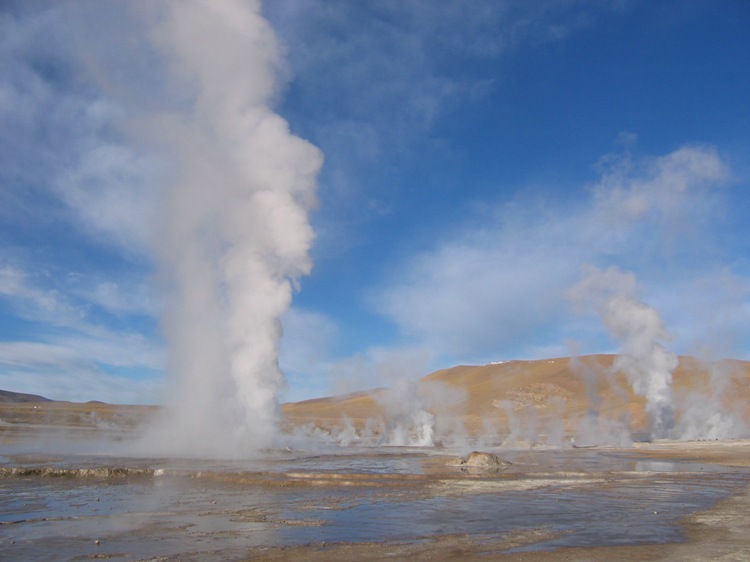
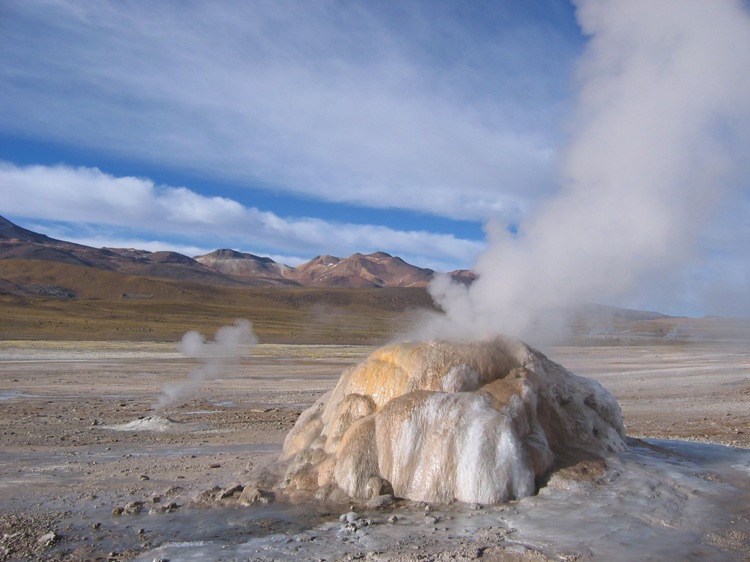
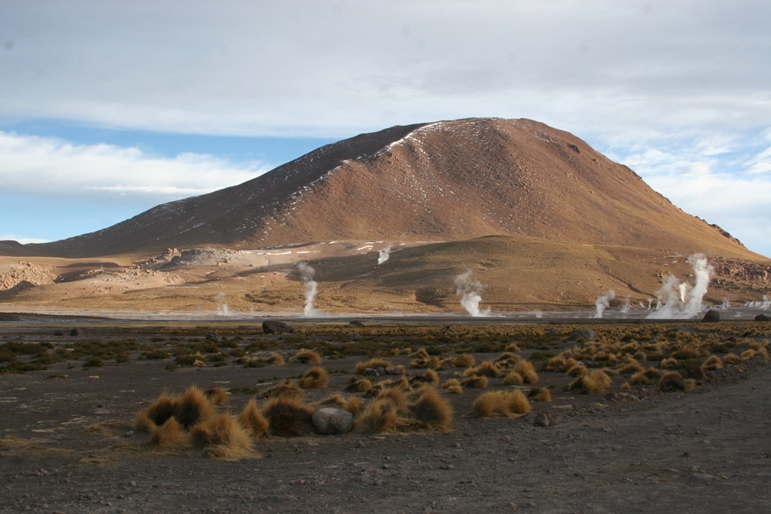
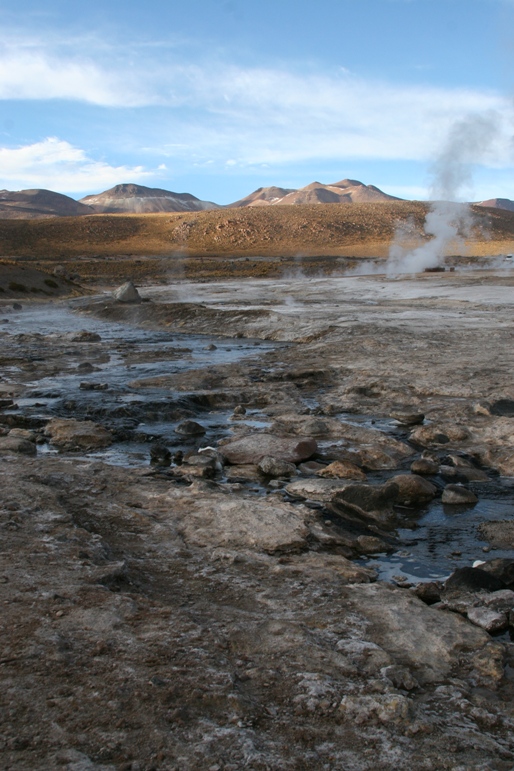
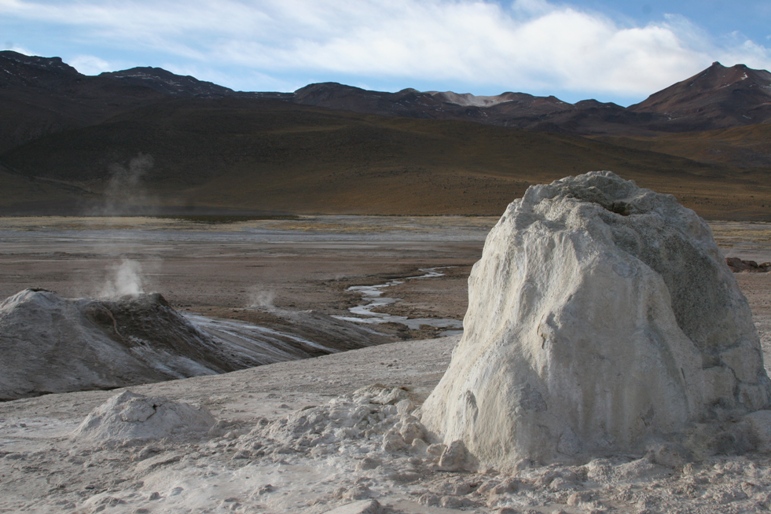
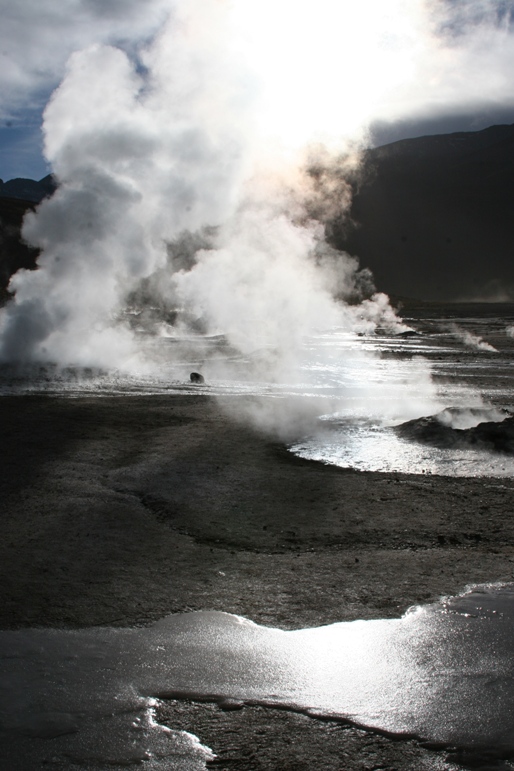
The geysers of El Tatio.
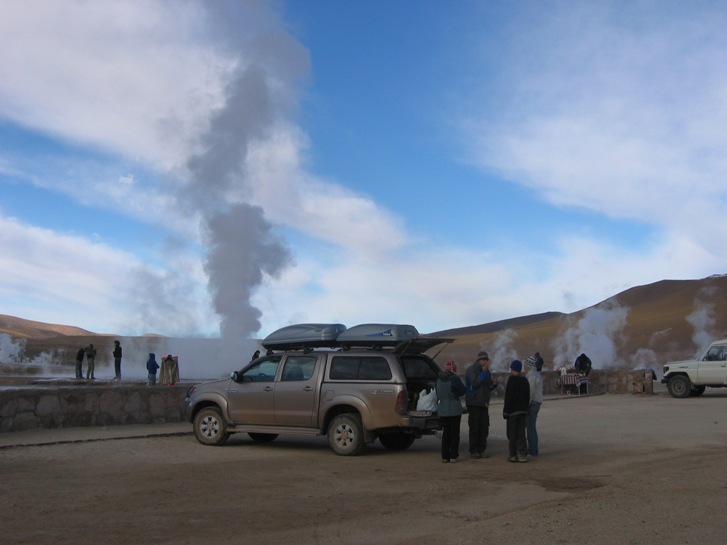
Cold Breakfast in the Cold Parking Lot.
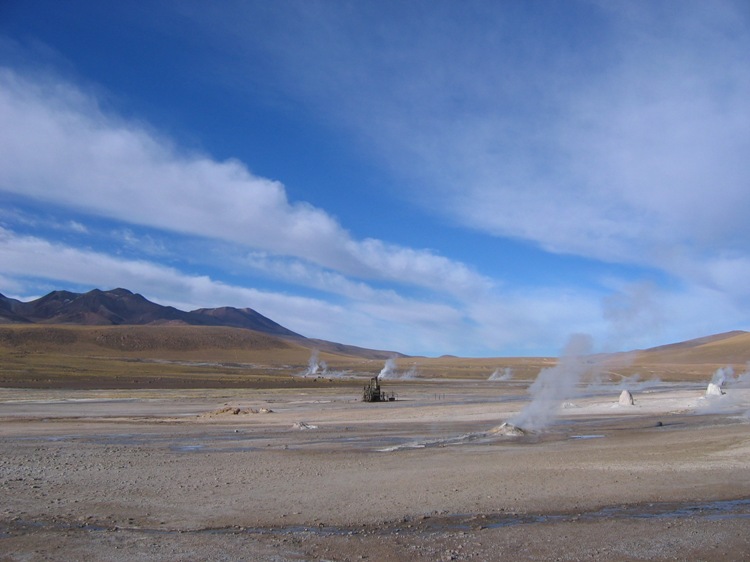
The signposts at the geysers tried to explain the phenomenon with all sorts of geological mumbo-jumbo, but I spotted this old mechanical contraption and figured out how I think things really work. They turn on this pump every morning at about 5am. It pumps water deep down into the ground until it reaches the magma heated depths below. Here the water is super-heated and steam pressure returns it to the surface through other various cracks and holes. They can turn the pump off before the day's throng of tourists arrive as the cycle takes a few hours to complete once set in motion. The arrival time of the first tourists determines how long the pump runs, how much water has been forced down, and hence for how long the geysers will spew.
When I posed this theory to Lynn, she immediately consulted her guidebooks in search of a rebuttal. Within a few seconds she was chuckling heartily. I asked her what was so funny about geysers and she replied, "Nothing, but listen to this: '... the road from San Pedro de Atacama has recently been significantly improved...' (from the Bradt Guide to Chile)."
Now that's funny! (or scary to think of what the road used to be like if the comment is actually true...).
Incidentally, the guidebooks confirm everything about my theory except the purpose of that pump kind of thing - they say it was placed there in an attempt to harness geo-thermal energy vs. initiate the the process.
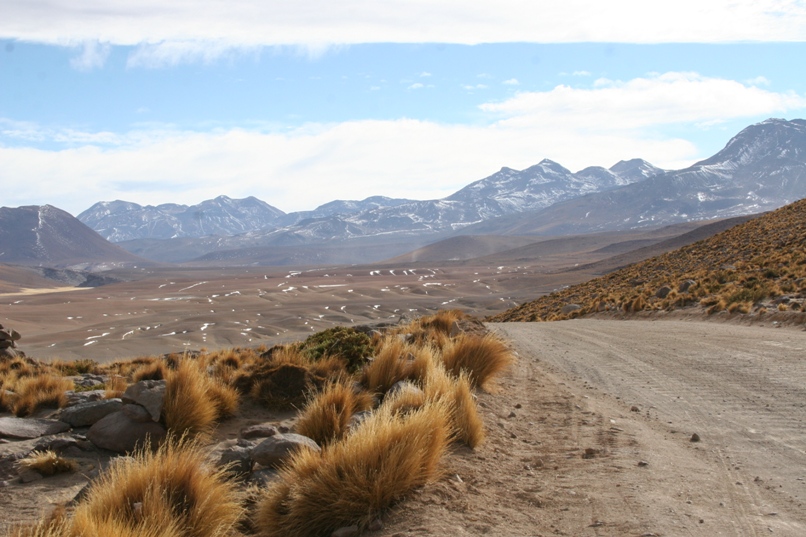
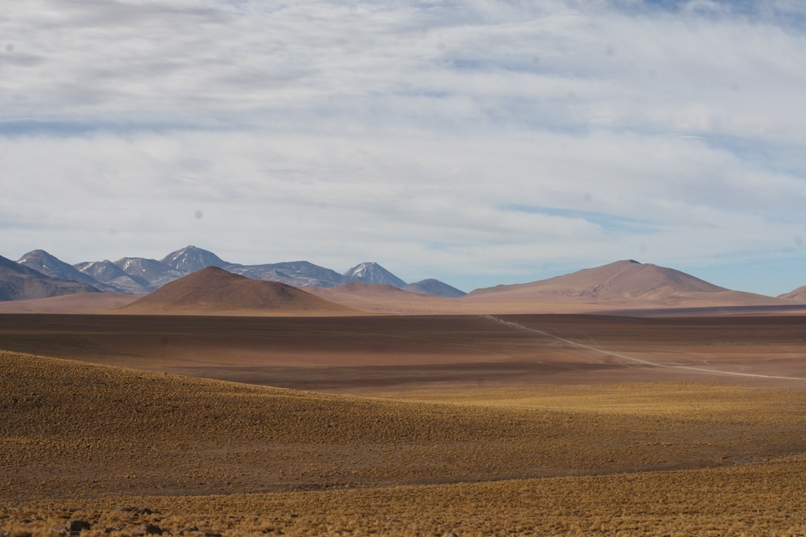
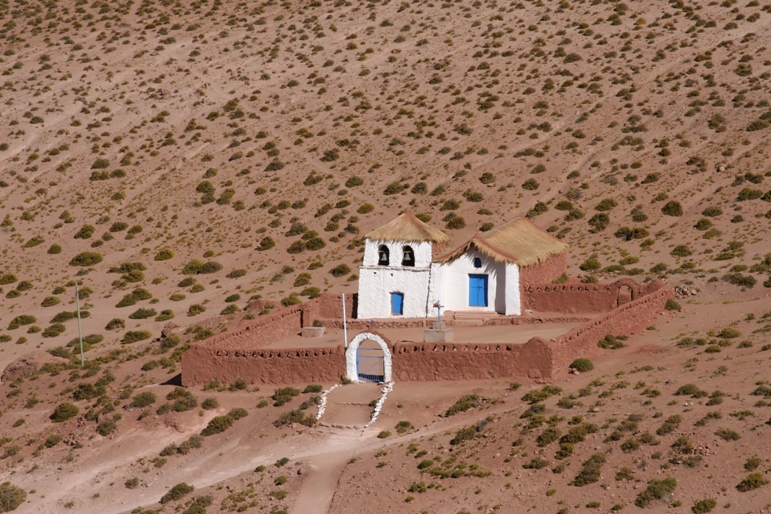
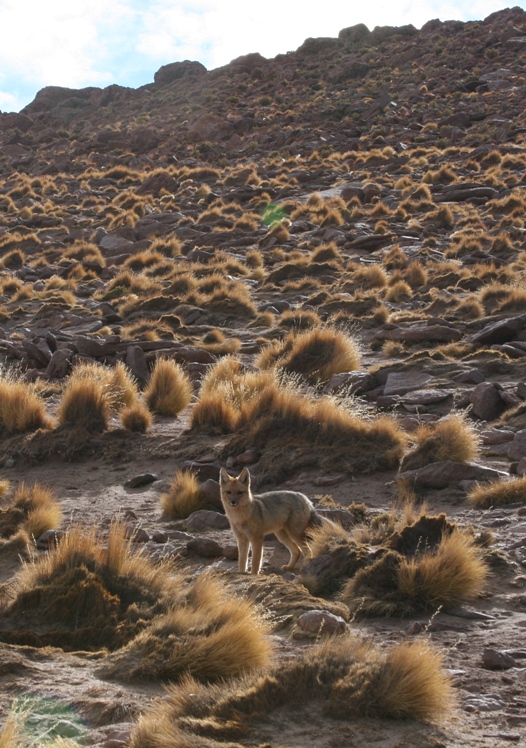
Now that the sun had risen, we could see what we were driving through on the trip back from the geysers!
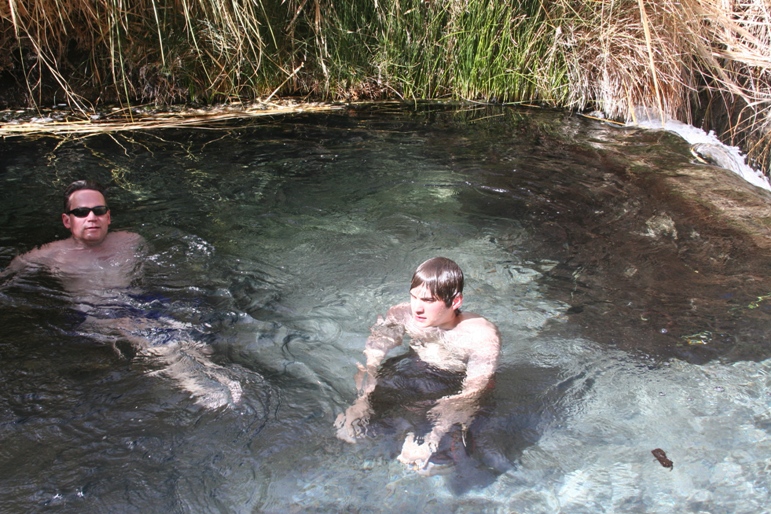
Relaxing in the termas.
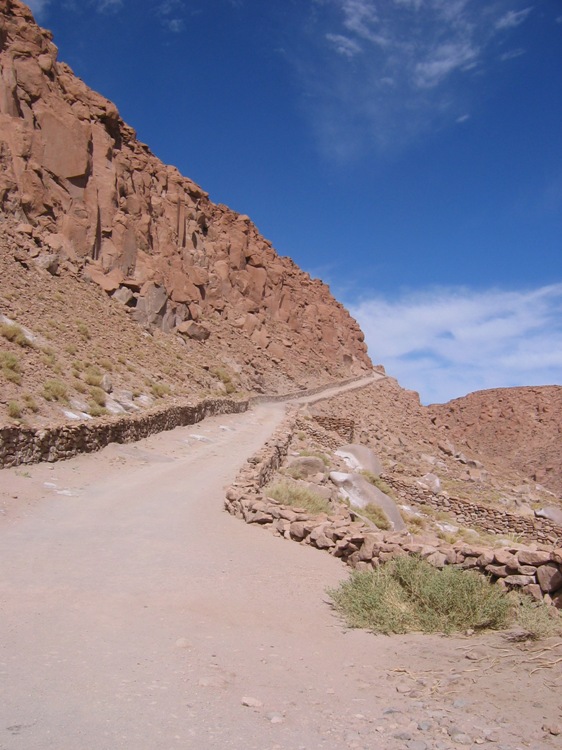
Was it worth $10 a piece and having to drive on this? The road gets even steeper (along with the cliff) around the bend. We were too terrified to stop there and take pictures.
**************************************************************
Along with the concentration of tourists and tourist shops and tourist hotels and tourist restaurants, San Pedro de Atacama has an elevated concentration of street dogs. They compose an entirely different, parallel social scene roaming the street, intermingling only a little with the humans. During the day they lie low, basking in the warm sun. At night, their energy picks up and they roam and rove in assorted packs, each with an alpha (or several wannabes) patrolling the perimeter, growling and snarling at potential usurpers. Fortunately, our hotel has thick stone walls, so the cacophony of interminable barking that accompanies the nightly canine party doesn't keep us awake all night long. It's more like a distant lullaby.
There's a large variety of strangely mixed breeds; shepherd-spaniel, labra-terrier, rottweiler-with-tail, chihuahua-dachshund, and dirty-mop mop dogs. They are cute, carefree, dirty, funny, and pathetic, all at the same time. When it comes to people, every single street dog is completely mild-mannered and deferential. Give one an angry glance and it will jump out of your way. It's like each one belongs to the whole population of the city, and every person is part-owner of each and every dog.
The human and canine worlds overlap at the trash cans and bags that the restaurants put out late every night. The big dogs must get first dibs. When I go for a walk in the early morning, the little ones are still poking at the leftover mess. Somehow it all gets eaten or otherwise cleaned up - mostly. By mid-morning the trash bags and residual trailings are gone from the street and the dogs have slunk off somewhere to commence a long day of napping.
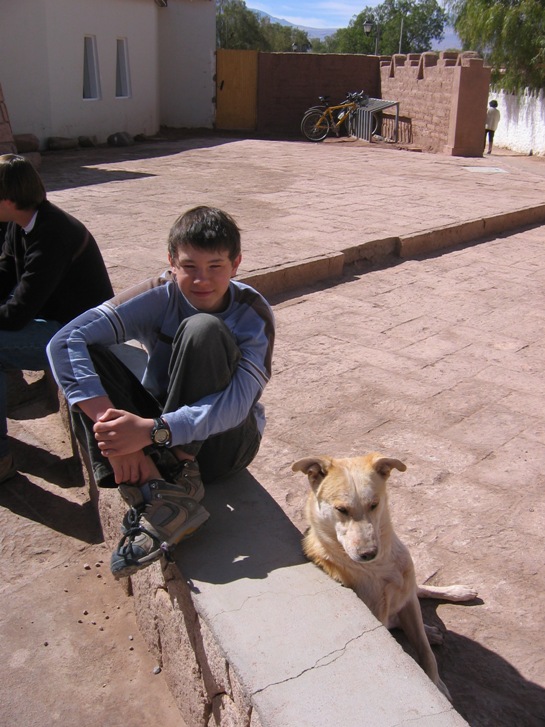
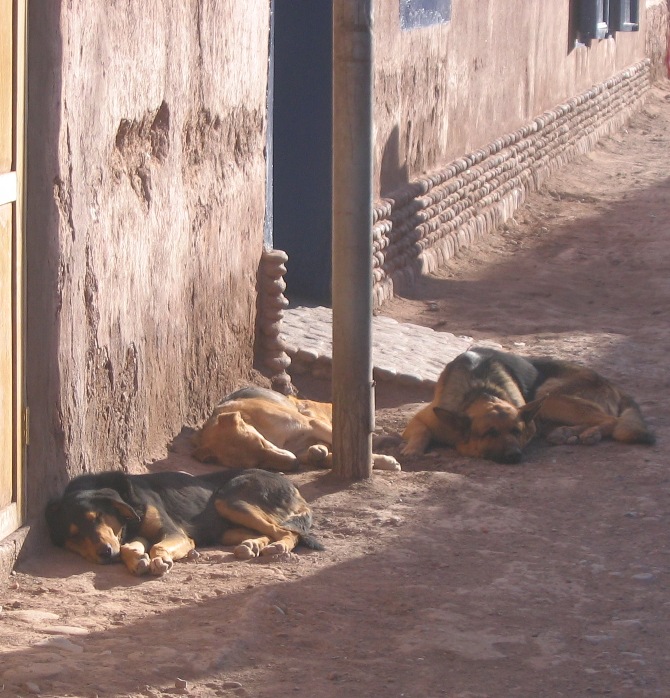
The mongrels of San Pedro de Atacama.
A women in my adult-school Spanish class visited Chile about a year ago, and upon her return complained to her classmates about the neglected street dogs in Chile. I think she must not have realized the conditions in which many of the people live! Things are what they are, and the sick dogs are sad, but most of them appear pretty happy to eat garbage, frolic about in packs all night, and sleep all day. At least they don't have to put on a suit and fight traffic to get to work.
-Rolf